

China Update News is increasingly defined by a single theme: the overlap of economics, technology, and national security. That was on full display across three major developments. First, Beijing reportedly ordered Meta to completely unwind its multibillion-dollar acquisition of AI startup Manus, even after the transaction had already closed and the companies had begun integrating staff, technology, and capital. Second, China’s industrial profit data showed strong headline growth in the first quarter, but the gains were concentrated in a narrow set of sectors while labor-intensive industries continued to weaken. Third, Italy extradited a Chinese national to the United States over alleged cyberespionage, adding another legal and diplomatic flashpoint to already tense US-China relations.
Taken together, these events point to a more fragmented global environment. Cross-border deals are becoming harder to complete, economic indicators are revealing uneven domestic conditions inside China, and cybersecurity cases are increasingly tied to great power politics rather than treated as isolated law enforcement matters.
Table of Contents
- Beijing moves to unwind Meta’s completed AI acquisition
- What the Meta-Manus case means for global tech investment
- China’s industrial profits rise sharply, but the recovery is uneven
- Italy extradites Chinese national to the United States
- Three trends these stories reveal
- FAQ
- Conclusion
Beijing moves to unwind Meta’s completed AI acquisition
The most dramatic development is Beijing’s intervention in Meta’s acquisition of the AI startup Manus. Reports indicate that Chinese authorities blocked the transaction on national security grounds and then went further by demanding that the deal be fully undone, despite the fact that it had already closed in December.
This is what makes the case so unusual. Regulators are not stopping a pending purchase before completion. They are reportedly requiring a reversal after the transfer of money, personnel, and technology has already taken place. In practical terms, that means asking Meta to separate systems that may already be integrated into its AI operations and to restore the target company’s Chinese assets to their prior state.

According to the reported demands, the unwinding would include several difficult steps:
Returning funds tied to the transaction
Re-registering ownership of the company
Stopping Meta’s use of the Manus algorithm
Removing any transferred data or technology from Meta’s systems
Restoring the Chinese assets associated with Manus
Each of those steps is hard on its own. Taken together, they create an exceptionally messy legal and technical challenge. Employees have reportedly already moved into Meta offices in Singapore. Executives from Manus have joined Meta’s expanding AI team. Investors have received proceeds from the sale. In other words, the integration process did not merely begin. It advanced.
Why this reversal is so difficult
Undoing a completed acquisition is far more complex than canceling one before closing. Once capital has changed hands, contracts have been executed, and employees have moved, the boundaries between buyer and seller become blurred.
Meta would likely have to answer several difficult questions:
How can integrated code or models be isolated and removed without disrupting other systems?
How should employee contracts and compensation be handled if staff have already changed employers?
Can investor payouts realistically be clawed back across multiple jurisdictions?
What counts as Chinese technology if the company operated through an international structure based in Singapore?
Those are not just technical questions. They involve corporate law, regulatory compliance, labor issues, intellectual property rights, and potential diplomatic exposure. This is why the order is being treated as far more than a routine antitrust or market review.
How much leverage does Beijing really have?
At first glance, Meta might appear insulated because its core social media platforms are blocked in China. But Beijing may still have meaningful leverage.
One major pressure point is advertising. Chinese companies reportedly generate well over $10 billion annually in revenue-sharing advertisements with Meta for marketing to overseas consumers outside China. Even if those advertisers want to stay on Meta’s platforms, state pressure could materially affect that business.
Another pressure point is manufacturing. Meta depends heavily on Chinese suppliers for products such as smart glasses. Supply chain interruptions would be costly for both sides, but they would still create immediate pressure.
There is also pressure on individuals. Reports indicate that Manus co-founders were summoned by regulators and instructed not to leave China during the investigation. At least two individuals were reportedly subject to exit restrictions. That suggests the case is not being treated as a simple corporate dispute. It is being handled as a matter with national security implications.
Why Beijing is intervening now
At the center of the dispute is strategic technology control. Manus reportedly operated internationally through a Singapore entity, but its origins trace back to Beijing-based Butterfly Effect Technology. From Beijing’s perspective, the issue is not merely where the deal was signed. It is whether strategically important AI capabilities tied to China are being absorbed into a major US technology company.
This reflects a broader shift in policy. China has spent years trying to move up the value chain in advanced manufacturing and frontier technologies. Artificial intelligence sits at the center of that ambition. If Chinese authorities now view AI models, algorithms, and related talent as strategic assets, then cross-border acquisitions in this area are likely to face tighter scrutiny and more political risk.
The case also sends a message beyond Meta. Global investors, venture capital firms, and startup founders may need to rethink assumptions about exits, ownership structures, and the portability of AI assets across borders. Deals that once looked commercial can rapidly become geopolitical.
What the Meta-Manus case means for global tech investment
The broader implication is that cross-border AI partnerships are becoming harder to separate from state competition. For years, global innovation thrived on a mix of foreign capital, talent mobility, and international corporate structures. That model is now under strain.
China’s major technology firms have historically benefited from overseas investment. At the same time, foreign technology companies have depended on Chinese supply chains, engineering talent, or commercial relationships. If regulators are willing to revisit and reverse completed deals in sensitive sectors, the cost of doing business rises sharply.
For global companies, the lesson is clear:
Political risk can outlast deal closing. Final signatures may no longer mean final certainty.
AI is now treated as strategic infrastructure. Algorithms and talent can trigger state intervention.
International deal structures offer less protection than before. A Singapore entity or offshore ownership does not necessarily shield a transaction from Chinese review.
Retaliation can extend beyond the deal itself. Advertising, supply chains, and individual mobility can all become levers.
For anyone following China Update News, this story is one of the clearest examples yet of how the US-China technology rivalry is moving from export controls and investment screening into a more aggressive phase.
China’s industrial profits rise sharply, but the recovery is uneven
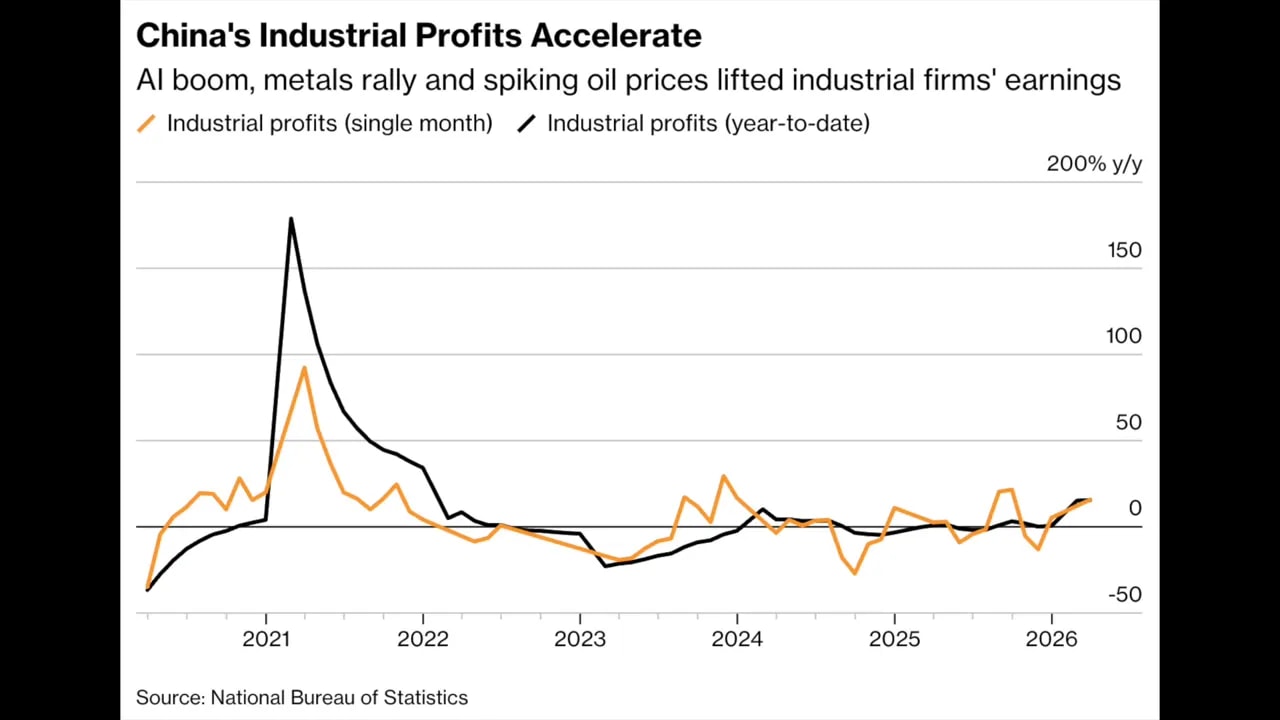
The second major development comes from China’s economy. Official data from the National Bureau of Statistics showed that industrial profits rose 15.5 percent in the first quarter, with March alone up 15.8 percent year on year. On the surface, those numbers suggest a meaningful rebound.
But the composition of the rebound matters far more than the headline. The profit gains were concentrated in upstream sectors such as energy, metals, and high-tech manufacturing, while many downstream consumer-facing industries continued to struggle.
Who is benefiting
The strongest gains came from sectors exposed to rising commodity prices and to demand linked with artificial intelligence infrastructure.
Key beneficiaries included:
Oil and gas producers, where profit declines narrowed significantly as crude prices rose amid geopolitical tensions
Non-ferrous metal mining, which continued to post strong growth
Electronics manufacturing, where profits reportedly surged 125 percent
High-tech manufacturing segments, including optical fiber, optoelectronics, and display technologies
The AI link is especially important. Global investment in data centers, chips, and related infrastructure is helping lift demand across parts of China’s industrial base. This supports Beijing’s long-term strategy of upgrading manufacturing and embedding the country more deeply in global advanced technology supply chains.
Who is struggling
The picture looks very different in labor-intensive industries. Apparel, footwear, and furniture manufacturing all reported double-digit profit declines. These sectors generally employ many more workers than the high-tech winners, which means their weakness has broader social and economic consequences.
Several factors are contributing to the pressure:
Rising input costs
Weak domestic consumer demand
Persistent overcapacity in some industries
Limited ability to pass higher costs on to customers
This is a familiar challenge in China’s economy. Producers may benefit from stronger factory-gate prices or commodity cycles, but that does not automatically translate into stronger household spending. If wages remain under pressure and consumers stay cautious, downstream manufacturers remain stuck in a low-margin environment.
A two-speed economy is taking shape
The latest data reinforces the idea of a two-speed economy. One track includes high-tech manufacturing, AI-linked electronics, and resource sectors that are benefiting from industrial policy and global capital spending. The other includes traditional manufacturers that depend more directly on broad consumer demand and face much harsher competition.
This split matters because it shapes the quality of China’s recovery. A rebound led by narrow industrial segments may look positive in aggregate data while still leaving much of the economy under strain. If only a few sectors generate profits and pricing power, then broader reflation becomes harder to achieve.
Economists are watching for signs that stronger industrial profits can spill over into:
Higher wages
Improved employment conditions
Stronger household consumption
More sustained domestic price recovery
Without that transmission, China could remain in a pattern where advanced sectors perform relatively well while traditional industries continue to absorb the burden of weak domestic demand and intense competition.
Why domestic pricing remains weak
Even with some improvement in industrial profits, domestic pricing power remains limited. Some exporters have started raising prices, which has helped narrow declines in export prices. But competition at home is still fierce, and price wars continue in sectors such as electric vehicles.
That matters because profits driven by a narrow set of favorable conditions are not the same as a healthy, broad-based recovery. If domestic firms cannot protect margins, the economy remains vulnerable to renewed slowdown once commodity support or overseas demand fades.
Italy extradites Chinese national to the United States
The third major story sits at the intersection of law enforcement, intelligence, and diplomacy. Italy extradited a Chinese national, identified as Xu Zewei, to the United States. He appeared in a Houston court after being transferred over the weekend and now faces a nine-count US indictment tied to alleged cyber intrusions between 2020 and 2021.
US prosecutors accuse him of targeting American universities and scientists working on COVID-19 vaccines during the pandemic. The allegations state that his actions were directed by China’s Ministry of State Security, specifically its Shanghai branch, and carried out through a contractor firm that infiltrated research networks and extracted sensitive data. Beijing denies the accusations.

The charges also connect Xu to the broader Hafnium hacking campaign, which compromised thousands of systems globally. That link increases the significance of the case because it places the extradition within a wider history of state-linked cyber allegations against China.
Why this case matters beyond cybercrime
This is not simply a criminal proceeding. It has immediate geopolitical implications.
Chinese officials condemned the extradition as political manipulation and demanded that Italy correct what they called its errors. The timing is especially sensitive because it comes shortly before a planned visit to Beijing by US President Donald Trump. That raises the possibility that the case could become entangled in high-level diplomacy.
Analysts cited in the reporting suggest China may try to secure Xu’s return, potentially through some form of prisoner exchange. Historically, cases involving alleged intelligence ties can evolve into bargaining chips. If Beijing chooses that route, the dispute could broaden well beyond the courtroom.
Risks for Italy and the broader diplomatic picture
Italy’s decision underscores the balancing act many middle powers now face. Aligning with Washington on a high-profile extradition may strengthen transatlantic coordination, but it can also create economic and diplomatic consequences with Beijing.
The case unfolds amid wider tension. The United States has expanded sanctions on Chinese firms, including action against an energy company over alleged links to Iran. China, for its part, has been expanding its own economic pressure toolkit even while signaling that it wants stable ties before major diplomatic engagements.
The result is a more unstable environment in which legal cases can quickly become part of a broader negotiation over trade, sanctions, intelligence, or detained nationals.
Three trends these stories reveal
Although these developments span different areas, they point in the same strategic direction.
1. National security is overriding commercial logic
The Meta-Manus case shows that a completed corporate transaction can be challenged if authorities decide the underlying technology is strategic. The old boundary between private business and state security is fading fast.
2. China’s economic recovery remains selective
Industrial data suggests real strength in parts of the economy, especially where policy support and global AI demand are aligned. But the weakness in labor-intensive sectors shows that the recovery is not evenly distributed.
3. Cyber disputes are now geopolitical tools
The extradition from Italy to the United States shows that alleged hacking cases are no longer narrow judicial matters. They can affect summits, alliances, sanctions, and detention diplomacy.
For policymakers, businesses, and investors, these are not isolated headlines. They are signals of a world where technology, law, and state power are becoming more tightly connected. That is one reason China Update News has become increasingly centered on systemic risk rather than single-issue reporting.
FAQ
Why is the Meta-Manus deal reversal considered so unusual?
Because the acquisition had already been completed. Funds had reportedly been paid, investors had received proceeds, employees had moved, and technology had been integrated. Reversing a closed transaction is far more difficult than blocking one before completion.
What leverage does China have over Meta if its platforms are blocked in China?
Meta still has business exposure through Chinese advertisers targeting overseas markets and through Chinese suppliers involved in product manufacturing. Both advertising revenue and supply chains can create pressure points.
What does China’s industrial profit growth actually show?
The headline numbers show strong first-quarter profit growth, but the gains are concentrated in upstream industries, electronics, and high-tech manufacturing. Many labor-intensive downstream sectors continue to report profit declines, suggesting an uneven recovery.
Why are labor-intensive industries in China under pressure?
They are being squeezed by rising input costs, weak domestic consumer demand, and limited pricing power. In many cases, firms cannot fully pass higher costs on to customers.
Why is the extradition from Italy to the US geopolitically significant?
The case involves allegations of state-directed cyber activity, which makes it more than a legal matter. It could affect US-China diplomacy, Italy’s relations with both countries, and broader negotiations involving sanctions, security, and detained individuals.
What is the bigger takeaway from these developments?
The bigger takeaway is that trade, technology, security, and diplomacy are becoming harder to separate. Corporate deals, industrial data, and cyber cases are all increasingly shaped by strategic competition between major powers.
Conclusion
The latest China Update News cycle shows how quickly commercial and legal developments can turn into geopolitical tests. Beijing’s reported demand that Meta undo a completed AI acquisition signals a far more assertive approach to controlling strategic technology. China’s industrial profit rebound reveals strength, but also a widening gap between policy-favored sectors and traditional manufacturers. And Italy’s extradition of an alleged Chinese hacker to the United States demonstrates how cybersecurity cases now sit squarely inside great power rivalry.
Each of these stories stands on its own. Together, they show a world in which economic integration remains real, but trust is thinning and political risk is rising. That is likely to remain a defining feature of China Update News for the foreseeable future.