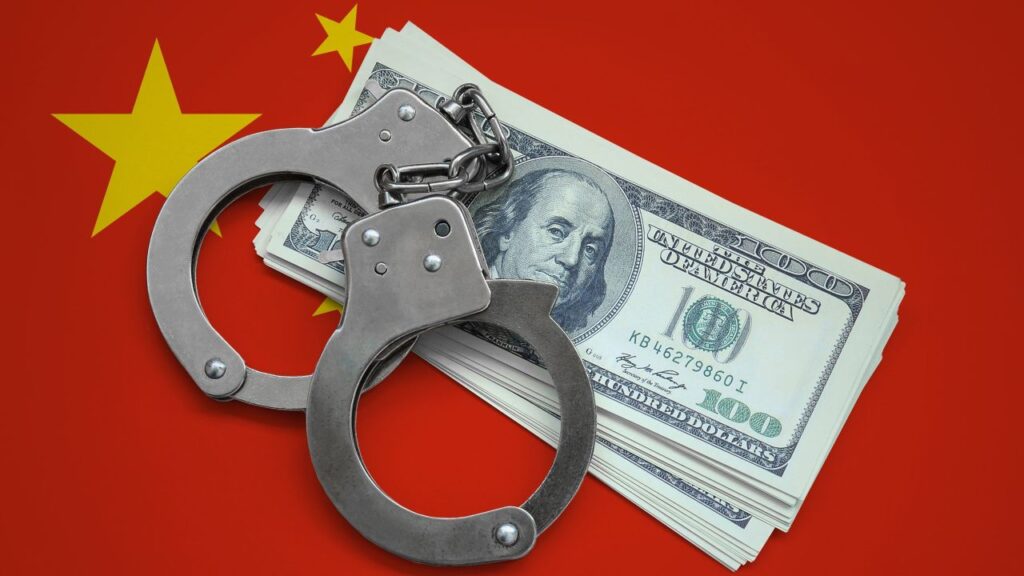
China update news this week points to a country facing pressure on multiple fronts at once. Economic growth remains uneven, with export manufacturing holding up while services, construction, and household demand remain weak. At the same time, a major anti-corruption case in Chongqing is exposing how political influence, business interests, and legal intermediaries may intersect. Beijing is also reframing youth disillusionment as a national security issue, blaming “hostile foreign forces” for the spread of the “lying flat” mindset. In parallel, new analysis of China’s military suggests that the People’s Liberation Army is becoming more capable even as political purges at the top raise questions about cohesion and command.
Taken together, these developments reveal a common theme: China’s leadership is trying to preserve control in an environment where structural weaknesses are becoming harder to ignore.
Table of Contents
- China’s economy is growing, but in an increasingly unbalanced way
- Chongqing corruption case shows the widening reach of Beijing’s purge
- Beijing turns “lying flat” into a security issue
- China’s military is stronger than before, but politics complicates the picture
- The Taiwan paradox: a stronger PLA and a disrupted high command
- The risk of war may be limited, but the balance is shifting
- What these stories reveal about China’s current trajectory
- FAQ
China’s economy is growing, but in an increasingly unbalanced way
The latest economic signals show a familiar but intensifying pattern. China’s manufacturing sector is still expanding, but much of that strength is being driven by external demand rather than domestic recovery.
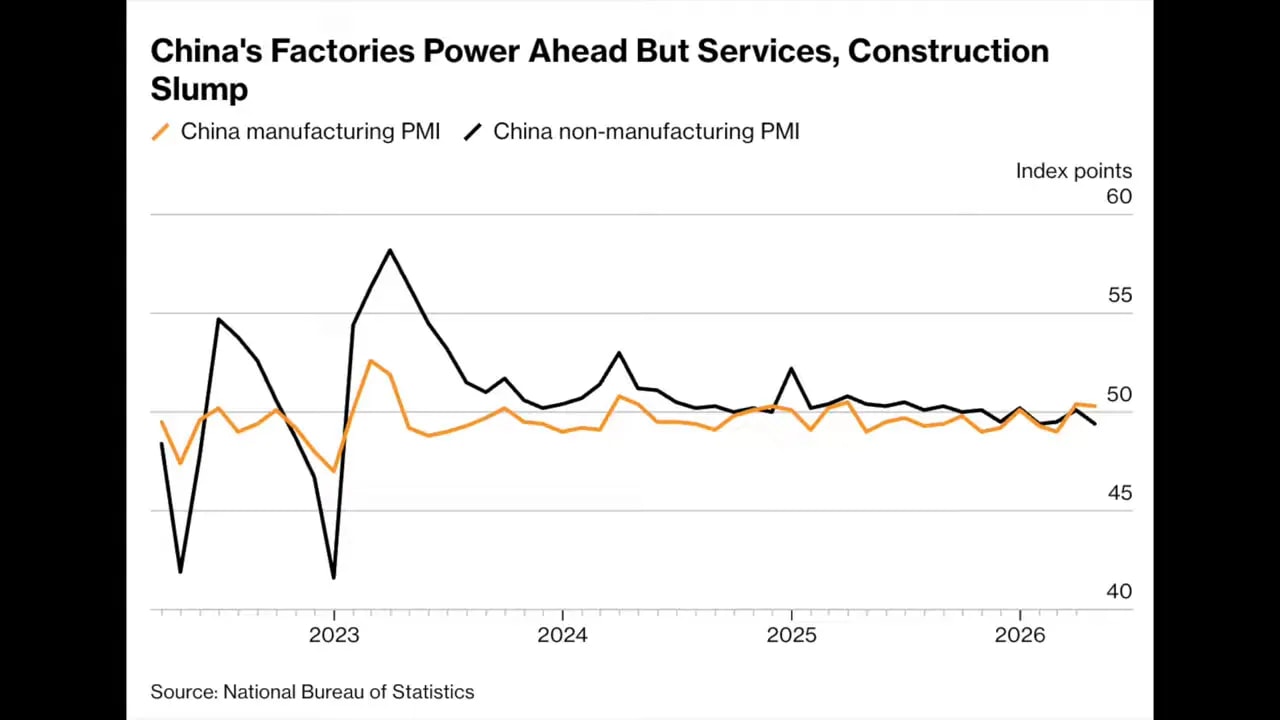
Official data showed the manufacturing Purchasing Managers’ Index, or PMI, at 50.3 in April, slightly down from 50.4 in March but still above the 50-point threshold that separates expansion from contraction. A private survey was even stronger, with manufacturing PMI rising to 52.2, its highest level since late 2020.
That matters because it suggests parts of China’s industrial economy remain resilient despite external disruption, including energy and commodity shocks linked to tensions in the Middle East. A key reason appears to be export demand. A sub-index for new export orders expanded for the first time in two years, indicating that foreign demand is helping sustain factory output.
Some of that demand appears tied to advanced manufacturing and sectors connected to artificial intelligence. Those areas have helped offset weakness elsewhere and reinforced a broader trend in China’s economy: manufacturing and exports continue to carry more of the growth burden.
Domestic demand is still the weak link
The problem is that the rest of the economy is not keeping pace. China’s official non-manufacturing PMI, which covers services and construction, fell to 49.4 from 50.1 in March. That puts the sector back into contraction.
The decline in construction was especially striking. The construction sub-index dropped to 48, its weakest level outside the initial Covid shock. That points directly to the long-running property downturn, which continues to weigh on employment, local government finances, and demand for a wide range of goods and services.
Services activity also softened, underlining the broader problem of subdued consumer demand. Household spending has struggled to regain momentum, and the hoped-for post-pandemic consumer rebound still looks fragile.
This widening gap between strong factories and weak domestic activity is more than a temporary mismatch. It reflects a deeper structural imbalance:
Exports are supporting output, especially in industrial sectors.
Consumption remains soft, limiting the recovery in services.
Construction is being dragged down by the property crisis.
Producer costs are rising, but companies are struggling to pass those costs to consumers.
That last point is especially important. Higher energy and commodity prices are squeezing margins, but weak demand means businesses often cannot raise final prices enough to protect profitability. This creates pressure across supply chains and raises the risk that headline growth numbers may overstate the health of underlying business conditions.
Why the current growth model looks vulnerable
There is also a sustainability problem. If export-led growth becomes the main engine while domestic demand remains weak, China becomes more exposed to changes in the global environment. A slowdown in overseas demand, higher oil prices, or prolonged geopolitical instability could hit the manufacturing sector that is currently doing much of the work.
Recent signals from Beijing suggest policymakers are not preparing a large-scale stimulus package. That caution may reflect concerns about debt, financial risk, or diminishing returns from old-style support measures. But it also means the economy remains exposed on two sides at once: internal fragility at home and external shocks abroad.
For anyone following China update news, this is one of the clearest themes right now. Growth has not disappeared, but it is becoming narrower, less balanced, and potentially more dependent on factors outside Beijing’s control.
Chongqing corruption case shows the widening reach of Beijing’s purge
A major anti-corruption investigation in Chongqing has moved beyond government officials and into the legal profession, signaling that Beijing’s campaign is expanding into the broader networks that connect power, money, and influence.
At the center of the case is Peng Jin, a prominent 58-year-old founding partner of a major Chongqing law firm. Her reported detention in April sent shockwaves through the city’s legal and political circles. Although not a Communist Party member, she had served three terms on the National Committee of the Chinese People’s Political Consultative Conference, an indicator of high political status and access.
Her case is unfolding amid a much larger crackdown that has already reached former Chongqing mayor Hu Henghua, vice mayor Jiang Duntao, and other senior local Party figures. The pace and scale of the investigations suggest a coordinated effort to dismantle entrenched networks in one of China’s most important municipalities.
Why this case stands out
Corruption cases involving officials are common in China’s political system. What makes this one more notable is the alleged role of a legal intermediary.
Peng is reported to have acted as a middleman in bribery schemes, using legal service agreements as a channel for illicit payments. In one especially striking allegation, investigators traced transfers involving tens of millions of dollars in cryptocurrency, including the stablecoin USDT, to third parties connected to her.
If accurate, that would highlight several important developments at once:
Corruption networks may be adapting to digital finance, including the use of crypto assets.
Law firms and professional service providers may play a larger role in political brokerage than is usually visible.
Anti-corruption efforts are moving beyond officeholders to target the ecosystem around them.
The political sensitivity is heightened by Peng’s family background. Her father was a former senior Chongqing official, and her brother has also reportedly come under investigation. That has raised fresh questions about how family ties and personal networks shape access inside China’s local power structures.
The larger meaning of the Chongqing purge
More broadly, the Chongqing crackdown appears to be about more than just individual wrongdoing. It reflects Beijing’s effort to reassert discipline over regional political systems where influence often flows through a mix of official positions, state-backed projects, commercial interests, and elite intermediaries.
The inclusion of a high-profile lawyer is especially revealing. Legal professionals are often less publicly visible than party secretaries, mayors, or state company executives. Yet they can sit at the intersection of contracts, dispute resolution, public projects, and political access. If authorities are now targeting these figures more directly, it suggests the anti-corruption campaign is broadening into the channels through which deals are arranged and protected.
That has two implications. First, it may deepen caution among business elites and advisers who operate near official power. Second, it reinforces the idea that anti-corruption in China is not only about clean governance. It is also about political control, network disruption, and re-centering authority in Beijing.
Beijing turns “lying flat” into a security issue
In a separate but revealing development, China’s top security agency has accused foreign forces of promoting the “lying flat” mindset among young people. The claim turns a social and economic frustration into a matter of national security.
“Lying flat” has become shorthand for withdrawal from intense competition and status-driven ambition. It expresses disillusionment with overwork, limited mobility, and the sense that effort no longer guarantees advancement. The phrase gained traction as many younger Chinese confronted expensive housing, intense labor expectations, and a labor market that could feel less rewarding than in earlier decades.
Now the Ministry of State Security has argued that hostile overseas actors are funding influencers, think tanks, and media voices to spread defeatist narratives among Chinese youth. The ministry described slogans such as “striving equals exploitation” and “lying flat is justice” as forms of “cognitive warfare” aimed at weakening China’s long-term development.

Why this message matters
The timing is significant. The warning came ahead of Youth Day on May 4, a politically symbolic date that emphasizes the role of young people in national renewal and modernization.
The official message is straightforward: youth passivity is not just a social concern but a strategic vulnerability. In this framing, ambition, work, and contribution are tied directly to national strength, while withdrawal and resignation are treated as threats to economic momentum.
At one level, the argument acknowledges that social pressures are real. Officials have suggested that rising living standards and domestic conditions contributed to the appeal of lying flat. But the emphasis remains on foreign manipulation rather than internal causes.
That matters because it shifts attention away from the structural drivers of youth frustration, including:
High living costs
Uneven job opportunities
Pressure from education and work culture
Perceptions of declining social mobility
By externalizing the problem, the state can frame disillusionment as a hostile narrative rather than a reflection of domestic economic and social strain.
A revealing contradiction in the official argument
Chinese authorities have also pointed to what they describe as hypocrisy from foreign countries. In Beijing’s telling, the same countries allegedly spreading passivity abroad are investing heavily in talent, innovation, and growth at home.
That argument is designed to cast ideological competition in strategic terms. It says, in effect, that psychological narratives can shape national power just as much as industrial policy or military spending.
Still, the underlying issue is difficult to dismiss with a security narrative alone. If large numbers of young people feel that effort brings diminishing returns, then “lying flat” is not merely a slogan imported from outside. It reflects real pressures inside the system.
That is why this episode stands out in China update news. It shows how Beijing is increasingly treating social mood, not just organized dissent, as something that must be managed through the language of security.
China’s military is stronger than before, but politics complicates the picture
Another major question hanging over China is whether the rapid modernization of the People’s Liberation Army has made it as formidable as it appears. Recent expert analysis presents a balanced answer: the PLA is far more capable than it was a generation ago, but its development is being complicated by political turbulence at the top.
A core point is that the PLA is not simply a national military in the conventional sense. It is the armed wing of the Communist Party. That distinction is crucial because the central issue for Xi Jinping is not only military effectiveness. It is whether the military remains politically loyal to the Party and to Xi personally.
This helps explain why the recent purges inside the military should be understood through a political lens. Corruption is the public explanation, but loyalty and control appear to be the deeper concern.
Why the purges matter
The scale of the recent military purges has been described as extraordinary, comparable in intensity to periods of severe political upheaval in earlier decades. Xi has removed not only potential rivals but also officers he himself promoted. That suggests the campaign is not a narrow factional struggle. It is a broader attempt to ensure that the PLA is disciplined, reliable, and able to carry out high-end operations if required.
At the same time, purges of this scale create uncertainty. They can weaken trust within command structures, disrupt institutional continuity, and signal that political compliance remains inseparable from military advancement.
The PLA’s real strengths
None of this means China’s military should be underestimated. On the contrary, the PLA today has major capabilities that were absent or underdeveloped in the 1990s.
Its strengths now include:
World-class missile forces
Sophisticated cyber capabilities
Counter-space systems
Improved global tracking of military movements
A force design oriented toward challenging the United States in the Western Pacific
China’s military modernization has been shaped by decades of studying how the United States fights wars. Since the Gulf War, Chinese strategists have examined precision strike systems, intelligence and surveillance networks, logistics, command systems, drones, and increasingly artificial intelligence.
That long period of observation has helped Beijing build a military designed to complicate U.S. operations, especially around Taiwan.
The PLA’s biggest weakness: lack of combat experience
Despite these gains, China’s military has not fought a war since 1979. That conflict with Vietnam exposed serious weaknesses at the time, and the long gap since then means the PLA has little recent combat experience.
This is not a minor issue. Studying war is not the same as fighting one. Any operation against Taiwan would be extraordinarily difficult. A blockade would be hard enough. An amphibious invasion would be vastly more complex, requiring the movement, landing, protection, resupply, and command of a massive force across the Taiwan Strait under potentially contested conditions and possible U.S. intervention.
In practical terms, that makes Taiwan one of the most demanding military scenarios in the world.
The Taiwan paradox: a stronger PLA and a disrupted high command
One of the most important conclusions from current analysis is the paradox at the center of China’s military posture. The PLA is becoming more dangerous, but Xi is simultaneously disrupting its senior leadership through purges and restructuring.
That combination suggests China may not be preparing for immediate war. If Xi believed conflict over Taiwan was imminent, it would make little sense to remove senior commanders and destabilize the top of the military hierarchy. Instead, Taiwan appears to remain a crisis to manage rather than a near-term operation to launch.
Another factor is Beijing’s assessment of the international environment. Chinese leaders may see time as still being on their side. Taiwan is politically divided. The United States faces multiple global distractions. If Beijing believes the strategic environment is relatively permissive, it may calculate that there is room to continue reforming and disciplining the PLA before any major confrontation.

What China may be learning from recent wars
Recent conflict involving the United States and Iran is also likely being studied closely in Beijing. Rather than simply concluding that U.S. military action is a warning, Chinese planners are likely extracting lessons about specific capabilities and operational demands.
Those lessons may include:
The growing role of artificial intelligence
The operational value of drones
The importance of long-range strike systems
The need for deep weapons stockpiles in prolonged conflict
China’s strategic advantage in this competition may be focus. Unlike the United States, which must prepare for multiple theaters and contingencies, China can concentrate much of its planning on one principal rival and one principal theater.
The risk of war may be limited, but the balance is shifting
Current expert assessments place the risk of U.S.-China war over the next decade as real but not high. Neither side wants a direct conflict, especially over Taiwan. Even so, danger could rise if policy changes sharply in Washington, Beijing, or Taipei.
One warning is particularly important: treating war as inevitable can make it more likely. If deterrence turns into a mindset that assumes China has already chosen conflict, policy can become rigid, escalatory, and self-fulfilling.
The longer-term concern may not be an immediate war at all. It may be the gradual erosion of U.S. military superiority if Washington remains distracted while China steadily modernizes. In that scenario, the balance of power could shift significantly without any direct clash.
That is the broader strategic takeaway. China’s military is formidable but not invincible. Its capabilities are real, and so is the political turbulence running through its leadership. Understanding China today requires holding both facts at the same time.
What these stories reveal about China’s current trajectory
These developments may seem disconnected, but they point in the same direction. China’s leadership is confronting economic weakness at home, control risks inside the political system, social frustration among youth, and uncertainty over military reliability. In each case, the response is not only technical or economic. It is political.
That pattern can be summarized in four points:
Economic problems are being managed cautiously, without major stimulus despite clear domestic weakness.
Elite networks are under pressure, as anti-corruption efforts move into legal and intermediary circles.
Social attitudes are being securitized, with youth disillusionment framed as foreign manipulation.
Military modernization continues alongside political purges, showing that loyalty remains central to command.
For anyone tracking China update news, this is the central lesson: the country’s challenges are no longer confined to one domain. Economics, politics, society, and security are increasingly overlapping, and Beijing’s instinct in each area is to tighten discipline while trying to preserve strategic flexibility.
FAQ
Why is China’s economic recovery considered unbalanced?
Because manufacturing and exports are still expanding while services, construction, and household demand remain weak. Factory activity is being supported by overseas orders, but domestic sectors tied to consumption and property continue to struggle.
What is significant about the Chongqing corruption case?
The case reportedly involves a prominent lawyer accused of acting as an intermediary in bribery schemes, including alleged cryptocurrency transfers. It suggests that anti-corruption efforts are expanding beyond officials to include the professional networks that connect business and politics.
What does “lying flat” mean in China?
“Lying flat” refers to a mindset of stepping back from intense competition, overwork, and conventional ambition. It is often associated with frustration over rising costs, limited social mobility, and a sense that hard work no longer guarantees progress.
Why is Beijing treating “lying flat” as a security issue?
Chinese authorities argue that passivity among youth weakens national development and can be exploited by foreign actors through what they call “cognitive warfare.” This framing turns a social trend into a strategic concern tied to economic and political resilience.
Is China’s military as strong as it looks?
China’s military is significantly more capable than it was a generation ago, with major advances in missiles, cyber tools, surveillance, and anti-access capabilities. However, it also faces important weaknesses, especially limited combat experience and political disruption caused by leadership purges.
Do the military purges mean China is preparing for war soon?
Not necessarily. One interpretation is that large-scale purges suggest Xi Jinping is still trying to consolidate loyalty and discipline within the PLA, which would be less likely if an immediate major conflict were expected.