
China update news this week was dominated by one especially consequential theme: pressure building across several fronts at once. The most significant development was a stark new warning about China’s demographic trajectory, with estimates pointing to a major population decline over the coming decade and growing stress on growth, consumption, pensions, and public finance. Alongside that, Taipei accused Beijing of pressuring African states to block the Taiwanese president’s travel route, a senior Finnish official cast doubt on any future EU-China trade deal, and Washington sanctioned a major Chinese refiner over Iranian oil.
Taken together, these developments point to a broader reality. China is not facing a single isolated challenge. It is dealing with overlapping domestic and international strains that reinforce each other: an aging population, weak consumption, fiscal pressures, diplomatic competition, and more confrontational external economic policy from the United States and Europe.
Table of Contents
- 1. Demographic decline moves from long-term risk to immediate economic problem
- 2. Why population decline could become a fiscal crisis
- 3. What this means for China’s economic model
- 4. Taiwan says African airspace denials were driven by Beijing
- 5. Finland signals a hard line on any future EU-China trade deal
- 6. US sanctions target a major Chinese refiner over Iranian oil
- 7. The larger pattern across this week’s developments
- FAQ
1. Demographic decline moves from long-term risk to immediate economic problem
The central story was the release of a Rhodium Group report titled China’s Demographic Future Is Now. Its argument is straightforward but severe: China’s demographic crisis is no longer a distant issue that policymakers can treat as tomorrow’s problem. It is already unfolding, and its effects are beginning to reshape the country’s economy and fiscal outlook.
The report estimates that China could lose nearly 60 million people over the next decade. That is roughly the population of France. It also suggests the pace of annual population decline could widen to as much as 7.6 million people per year by 2035.
Those are exceptionally large numbers for a country whose development model has long depended on a vast labor force, rising urbanization, and expectations of expanding domestic demand.
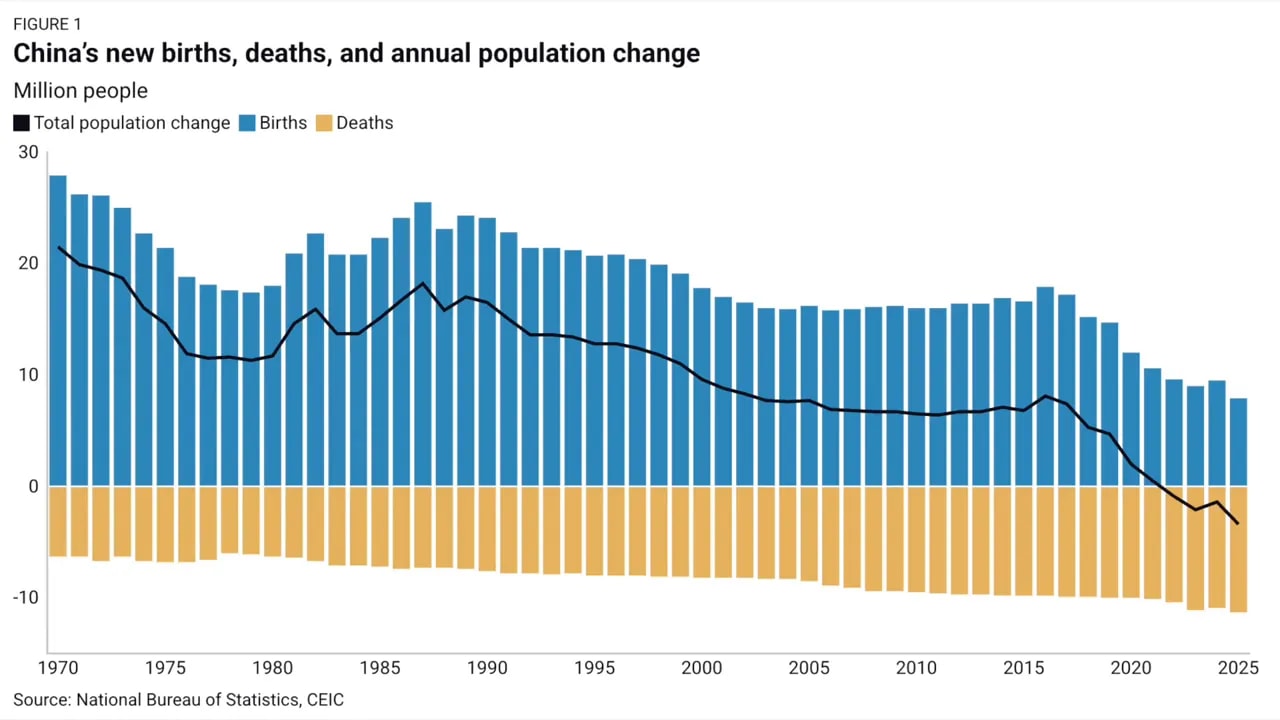
Births are falling fast
One of the clearest indicators is the decline in births. China reportedly recorded just 7.92 million births in 2025, less than half the level seen a decade earlier. That places current birth numbers in territory comparable to the 1930s, despite a modern population more than twice as large as in that earlier period.
At the same time, deaths are rising as the population ages. The result is not simply slower growth. It is outright population contraction, and at an accelerating pace.
This matters because demographics influence far more than headline population size. They shape:
Consumer demand, since fewer households and slower income growth weaken spending
Labor supply, as the pool of working-age people shrinks
Public finance, as more retirees depend on fewer contributors
Regional development, especially in places already facing stagnation
Why policy has not reversed the trend
Beijing has already abandoned the one-child policy and rolled out pro-natalist measures, but births have continued to fall. That reflects a pattern also seen in other low-fertility societies: once fertility drops far enough, policy can slow the decline but often cannot reverse it.
The causes are structural and social as much as political. The main factors identified include:
Later marriage
Fewer marriages overall
Higher education levels
Economic uncertainty
Less stable employment, including gig work
Weaker interest in family formation among younger generations
China is not unique in facing these trends. Japan and South Korea have confronted similar issues. The difference is that those countries became wealthy before demographic decline became so severe. China risks entering that same pattern at a much lower income level.
COVID and zero-COVID likely worsened the trend
The argument also highlights the role of the pandemic period. COVID-19 itself mattered, but so did the policy response. Years of strict zero-COVID controls likely intensified economic uncertainty and social disruption, worsening already negative trends in fertility, household confidence, and local government finance.
That does not mean COVID created the demographic problem. It means it may have accelerated an underlying problem that was already present.

2. Why population decline could become a fiscal crisis
The most serious implication may be fiscal rather than demographic in the narrow sense. Population decline means fewer workers, more retirees, and growing pressure on social security systems that are already strained.
In 2025, the government reportedly injected 2.9 trillion yuan into the social security system, equivalent to more than 10 percent of total budget spending. Without such transfers, the system would already be running a significant deficit.
The pension fund appears especially imbalanced, with spending outpacing contributions. Pension stress is common in aging societies, but the concern in China is sharper because parts of the welfare system remain modest even by middle-income standards.
For example, rural pensions can be extremely low, yet even these limited payments are difficult for many fiscally stressed local governments to sustain.
The dependency ratio is deteriorating
A key measure here is the dependency ratio: how many working-age people support each retiree. In 2024, China had roughly 4.4 working-age individuals per retiree. By 2035, that figure is projected to fall to just 2.8.
That shift has immediate consequences:
Less payroll support for pensions
More pressure for central government transfers
Potential tax increases
Possible benefit cuts
Greater borrowing needs
Each option carries costs. Higher taxes can weaken growth. Lower benefits can increase elderly poverty. More borrowing can strain already burdened public finances.
Regional imbalances make the problem harder
China’s most productive coastal provinces are now facing natural population declines as well. Their growth is being sustained mainly through internal migration rather than organic population increase. That weakens the future consumption and productivity potential of the very regions that have long driven national economic expansion.
Meanwhile, the northeast continues to face a combination of low birth rates and economic stagnation. That creates a difficult regional picture: some areas are aging after decades of industrial slowdown, while stronger coastal provinces are no longer guaranteed demographic momentum.
3. What this means for China’s economic model
For years, one of the major questions in Chinese economic policy has been whether the country can shift toward a more consumption-driven growth model. Demographic decline makes that transition harder.
Household consumption was already a weaker pillar of the economy than investment and exports. Now it faces additional pressure from slower population growth, weaker income growth, soft employment conditions, and a more cautious consumer mood.
That combination raises the risk of a self-reinforcing cycle:
Fewer births and slower population growth reduce future household formation.
Weak labor and income prospects suppress current spending.
Lower consumption reduces business confidence and investment.
Slower growth makes family formation less attractive.
This is part of why some analysts fear a period of Japan-style stagnation, but at a much lower level of wealth. In that scenario, weak consumption, low inflation or deflation, and declining investment become entrenched.

Can automation solve the problem?
Automation and artificial intelligence may help offset some labor shortages, especially in manufacturing and advanced industry. But technology is not a full solution to demographic decline.
Automation can support output with fewer workers. It cannot, by itself, recreate lost household demand, restore marriage rates, or stabilize local pension systems. It may also introduce new employment uncertainty, which can further discourage births.
So while productivity-enhancing technology matters, it does not eliminate the structural effects of aging and population contraction.
Economic decline does not automatically mean geopolitical retreat
An important distinction follows from this. Demographic and economic decline do not necessarily imply political fragmentation or withdrawal from the world stage. A centralized Leninist system can choose to prioritize strategic sectors, military investment, and geopolitical ambitions even under domestic strain.
That means external behavior may not become softer just because internal conditions worsen. In some cases, insecurity at the top can make a state more assertive rather than less.
This is one reason the demographic story matters beyond economics. It affects how China may govern, allocate resources, and define national priorities over the next decade.
4. Taiwan says African airspace denials were driven by Beijing
Another notable item in China update news involved Taiwan’s president, William Lai Ching-te, who was forced to cancel a planned trip to Eswatini after several African countries denied overflight permission.
According to Taiwanese officials, Seychelles, Mauritius, and Madagascar unexpectedly revoked previously granted access for the aircraft to use their airspace. Taipei said the move came after intense pressure from Beijing.
The allegation is significant because it suggests Chinese pressure may now extend beyond formal diplomatic recognition and into aviation access and logistical transit.

Why the incident matters
China has long opposed any international treatment of Taiwan that resembles state-to-state recognition. But if governments can be persuaded or pressured to deny basic overflight access, that broadens the field of contest considerably.
Taiwanese officials suggested Beijing may have used potential economic coercion, including financial leverage or debt-related pressure, to influence the decisions. China did not publicly comment on the specific accusation in the material covered here, but the broader pattern aligns with its longstanding effort to restrict Taiwan’s international space.
The implications go beyond Taiwan alone. If airspace permissions can become instruments of geopolitical leverage, that raises broader questions about sovereignty, diplomatic autonomy, and the use of economic influence in third countries.
For Taiwan, it is another reminder that international engagement can be constrained not only by formal recognition disputes, but also by practical obstacles such as transit access.
5. Finland signals a hard line on any future EU-China trade deal
Europe’s internal debate over China also sharpened. Finland’s foreign minister, Elina Valtonen, said Beijing’s relationship with Moscow should be a “disqualifying factor” for launching negotiations on a free trade agreement between the European Union and China.
That position matters because any such deal would require unanimous support from all 27 EU member states. In practical terms, a strong objection from one member can become a veto point.
The comments came as China has floated the idea of restarting trade or investment discussions with Europe. But the political environment remains deeply unfavorable.

Ukraine is now central to Europe’s China policy
The core problem is China’s stance on Russia’s war in Ukraine. Many European officials are frustrated that Beijing has not condemned Moscow, and there are additional concerns about Chinese firms supplying dual-use goods that could aid Russia’s military effort.
Valtonen argued that China benefits economically from the war, with Russia functioning as a junior partner supplying discounted resources. Whether or not all EU capitals would frame it so bluntly, the statement reflects a hardening mood in parts of Europe.
Trade issues are compounding geopolitical mistrust
The EU-China investment agreement has effectively been frozen since 2021 following mutual sanctions over human rights issues. On top of that, European governments remain concerned about:
Chinese industrial subsidies
Overcapacity in key sectors
Potential market distortion from low-cost exports
The EU is not fully unified. Different member states have different interests. France is more defensive about Chinese cars entering Europe, while Germany has stronger incentives to preserve access to the Chinese market for its own exporters. Still, the broader picture is clear: geopolitical friction is making major new trade agreements with China increasingly difficult.
6. US sanctions target a major Chinese refiner over Iranian oil
The final major development involved rising US-China tension tied to Iran. The United States sanctioned Hengli Petrochemical, a major Chinese oil refiner, as part of a broader effort to pressure Tehran by targeting the commercial networks that help move Iranian crude.
The refinery’s large complex in Dalian province has processing capacity of roughly 400,000 barrels per day, making it one of the biggest private-sector refining facilities in China. Private refiners of this kind are often referred to as “teapot” refiners, though some are now very large by global standards.

Why the sanctions matter
US officials argue that purchases of Iranian oil generate billions of dollars for Tehran and indirectly support its military and strategic activities. The sanctions therefore go beyond energy trade. They form part of a wider effort to disrupt what Washington sees as a sanctions-evasion network.
In addition to targeting the refinery, the US also blacklisted around 40 shipping firms and tankers linked to Iran’s so-called shadow fleet. These networks often rely on tactics such as:
Disabling tracking systems
Ship-to-ship transfers at sea
Rebranding cargoes to disguise origin
Transfers near Malaysia were specifically mentioned as part of the method used to obscure oil movements before crude enters global markets, particularly China.
China’s role in Iranian oil trade
China remains the largest buyer of Iranian oil, accounting for an estimated 80 to 90 percent of exports before the recent Middle East escalation referenced here. Official Chinese import data may not show direct purchases, but intermediaries and reclassification have allowed the trade to continue largely out of formal sight.
The sanctions also arrived amid tensions in the Strait of Hormuz, one of the world’s most important energy chokepoints. Disruptions there have added volatility to oil and gas markets and increased concerns about supply risk.
A more aggressive US approach
The broader message is that Washington appears more willing to impose costs on major Chinese entities connected to sensitive geopolitical issues. That suggests a more aggressive form of economic statecraft, one less deterred by the possibility of bilateral friction or commercial blowback.
Beijing has previously criticized such measures as harmful to legitimate business interests and inconsistent with global trade norms. But the direction of travel is clear: US-China tensions are no longer limited to tariffs, semiconductors, or industrial policy. Energy flows tied to Iran are now a more visible part of the relationship.
7. The larger pattern across this week’s developments
What links these stories is not that they are identical, but that they reveal simultaneous pressure across domestic and external domains.
On the domestic side, demographic decline threatens growth, consumption, pension sustainability, and local government finances. On the external side, China faces a more contested environment in aviation diplomacy involving Taiwan, a more skeptical Europe, and a more punitive United States using sanctions to target Chinese firms tied to adversarial states.
This combination matters because internal weakness can narrow policy choices just as external competition intensifies. A government under rising fiscal and demographic strain may still pursue ambitious strategic goals, but doing so becomes more expensive and politically complex.
That is why the demographic story should not be read in isolation. It is not only about births and aging. It is about the future resilience of the Chinese state and economy in a period of mounting geopolitical rivalry.
FAQ
Why is China’s demographic decline considered such a major economic issue?
Because population decline affects several core parts of the economy at once. Fewer births today mean fewer workers and consumers tomorrow. An aging population also increases pension and healthcare burdens while reducing the number of contributors supporting those systems. That can weaken consumption, labor supply, and public finance simultaneously.
Can China reverse falling birth rates through policy?
Policy may slow the decline, but reversing it is much harder. China has already ended the one-child policy and introduced incentives, yet births have kept falling. Social and economic factors such as delayed marriage, insecure employment, and changing attitudes toward family formation are proving difficult to change quickly.
What was the controversy around Taiwan’s canceled Africa trip?
Taiwan said several African countries revoked overflight permission for President William Lai Ching-te’s aircraft after pressure from Beijing. If accurate, the episode would show how competition over Taiwan can extend into practical areas like airspace access, not just formal diplomatic recognition.
Why is Finland’s position on EU-China trade important?
Any EU-China free trade agreement would require support from all EU member states. Finland’s foreign minister said China’s ties with Russia should disqualify it from such negotiations, meaning even one determined member state can significantly complicate future talks.
Why did the United States sanction a Chinese oil refiner?
The United States says the refinery helped purchase Iranian crude oil, generating revenue for Tehran and supporting a sanctions-evasion network. The move is part of a broader effort to disrupt oil flows linked to Iran by targeting refiners, shipping firms, and tankers involved in the trade.
Does demographic decline mean China will become less influential internationally?
Not necessarily. Economic and demographic strain can limit resources over time, but they do not automatically produce geopolitical retreat. A centralized state can still prioritize military, technological, or strategic goals even while facing domestic challenges, though doing so may increase internal tradeoffs.
China update news rarely centers on a single issue for long, but the demographic warning stands out because it touches nearly every other question about the country’s future. A shrinking population means more than fewer people. It means a different economic structure, a different fiscal burden, and potentially different political priorities.
At the same time, this week’s developments on Taiwan, Europe, and Iran show that external pressure is not easing. China is entering a period in which domestic structural constraints and international strategic friction are converging. That makes policy responses more difficult and outcomes more consequential.
For anyone following China update news closely, the takeaway is not that one report or one diplomatic incident determines the future. It is that several major trend lines are now moving in the same direction: toward a more complicated, more constrained, and more contested phase in China’s development.