China Update News this week centers on three developments that reveal how competition with China is increasingly being fought across technology, law enforcement, and trade policy. The first is a sharp escalation in U.S. accusations that Chinese actors are extracting advanced American artificial intelligence capabilities at industrial scale. The second is a renewed China-Cambodia push against online scam compounds and human trafficking networks in Southeast Asia. The third is a broader argument from former U.S. Trade Representative Robert E. Lighthizer that the global economy is moving away from hyper-globalization and toward a more strategic, security-focused trade system.
Taken together, these stories point to a larger pattern. China’s rise is no longer debated only in terms of growth rates or export volumes. It is now tied to who controls advanced technology, who can police transnational criminal networks, and who gets to rewrite the rules of global commerce.
Table of Contents
- U.S. accuses Chinese actors of large-scale AI model extraction
- China and Cambodia target scam compounds and trafficking networks
- Lighthizer argues the world is leaving hyper-globalization behind
- The broader pattern across all three stories
- FAQ
- Final takeaway
U.S. accuses Chinese actors of large-scale AI model extraction
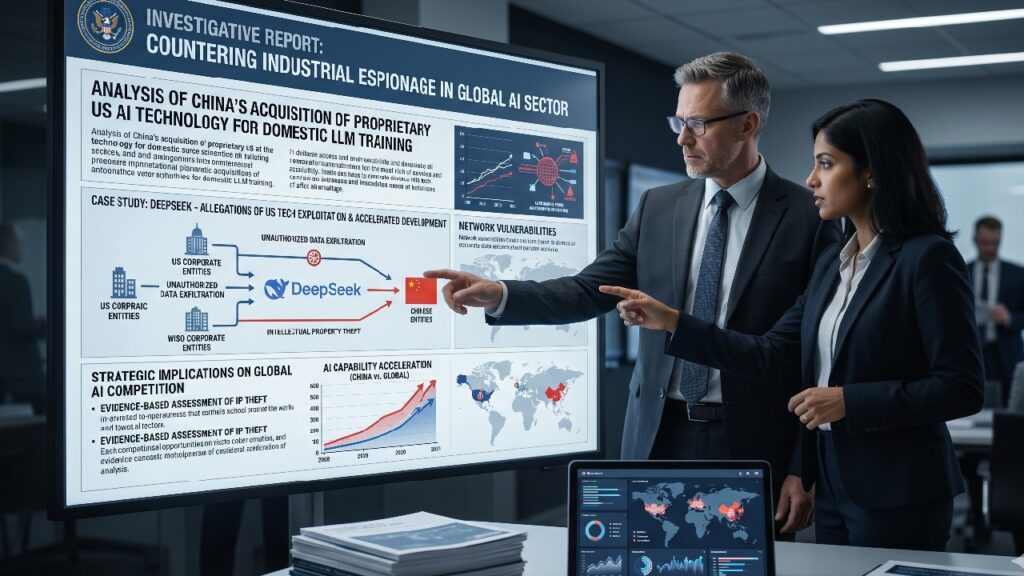
The most consequential development came from Washington, where the White House released a memo titled Adversarial Distillation of American AI Models. The document argues that foreign entities, mainly based in China, are systematically attempting to extract and replicate the behavior of leading U.S. artificial intelligence systems.

At the center of the allegation is a machine learning process known as distillation. In normal technical use, distillation is legitimate. It allows a smaller model to learn from the outputs of a larger, more capable model. This can improve efficiency, lower costs, and make AI systems easier to deploy.
The U.S. concern is not with distillation itself, but with how it is allegedly being used. Officials say the process has been turned into a tool for unauthorized capability transfer. In practical terms, that means querying advanced American models at large scale, collecting enough outputs to infer their patterns, and then training smaller systems that can reproduce similar performance on selected tasks.
According to the White House, these efforts involve:
- Tens of thousands of proxy accounts used to access AI services
- Jailbreaking techniques designed to bypass safeguards and usage restrictions
- Large-scale querying patterns aimed at extracting model behavior
- Indirect access methods such as VPNs, rented U.S. phone numbers, and foreign payment channels
The underlying claim is significant. American officials argue that Chinese developers may be using the outputs of U.S. frontier models to shortcut years of expensive research and billions of dollars in investment. Even if the resulting systems are not exact copies, they may still perform competitively in specific areas while costing far less to build.
Why this matters beyond intellectual property
The White House warning goes beyond theft in the conventional commercial sense. It also argues that unauthorized model extraction can strip away important safety features built into American systems.
Those protections may include limits related to:
- Misinformation generation
- Bias mitigation
- Misuse prevention
- Hacking assistance
- Other high-risk behaviors
If developers copy capabilities without preserving the original safeguards, they may release models that are more dangerous even if they are less advanced overall. That possibility turns the issue from a business dispute into a national security and governance problem.
It also helps explain why AI policy is now being treated as a strategic field, not just a commercial one. The contest is no longer simply about who can build the best model. It is increasingly about who controls the infrastructure, data access, compute resources, and know-how required to build and maintain those models.
DeepSeek and the widening debate over Chinese AI progress
Scrutiny intensified after the emergence of DeepSeek, whose advanced models surprised global markets with their efficiency and performance. Some U.S. developers and policymakers have questioned whether that rapid progress reflects original innovation, large-scale distillation from American systems, or some combination of both.
No definitive public proof was presented tying a specific Chinese model to unlawful extraction. That uncertainty is important. AI systems are difficult to audit from the outside, and there is often no clean line between inspiration, benchmarking, open scientific exchange, and improper replication.
Still, the White House position marks a clear escalation. The administration says it is increasing coordination with private companies, sharing intelligence about suspicious activity, and exploring stronger defenses against model extraction. It also signaled that foreign actors could eventually face legal or economic consequences.
Beijing’s response and the problem of enforcement
Beijing rejected the allegations outright. A spokesperson for the Chinese embassy in Washington described the claims as “pure slander” and said China supports technological progress through fair competition while respecting intellectual property rights.
That response follows a familiar pattern in the U.S.-China technology rivalry. Washington frames the issue as national security and protection of innovation. Beijing frames it as political containment and an effort to discredit Chinese technological advancement.
The deeper difficulty is enforcement. AI systems operate in a globally connected digital ecosystem. Geographic restrictions can be bypassed, cloud services can be accessed indirectly, and model outputs can travel far more easily than physical goods. This creates a cat-and-mouse environment where controls exist, but are hard to police fully.
For that reason, this latest story from China Update News is not just about one accusation. It points to a future in which AI rivalry is likely to involve tighter controls, more monitoring, and greater friction between open innovation and strategic restriction.
China and Cambodia target scam compounds and trafficking networks
A second major development came from Southeast Asia, where China and Cambodia pledged to intensify their crackdown on sprawling online scam and human trafficking operations. The issue was elevated during a high-level “2 plus 2” strategic dialogue involving the two countries’ foreign and defense ministers.
Chinese Foreign Minister Wang Yi said both sides would work to “resolutely and thoroughly” combat telecom fraud and online gambling. Cambodian leader Hun Sen also stressed that these operations harm victims around the world and damage Cambodia’s international reputation.

This is not a minor law enforcement issue. Scam compounds in parts of Southeast Asia have become one of the region’s most notorious criminal industries. They are often linked to cyber fraud, fake investment schemes, forced labor, and cross-border trafficking.
The victims are not limited to those who lose money. Authorities and researchers have increasingly documented how thousands of workers have been deceived or trafficked into these compounds, then forced to run scams under violent and coercive conditions.
The regional scam economy
These compounds have flourished in areas with weak governance, porous borders, and corruption. Criminal networks exploit legal gray zones and local political protection to operate at large scale. They frequently target Chinese citizens, Americans, and other international victims through online romance scams, fake crypto investments, and fraudulent financial platforms.
The renewed China-Cambodia coordination suggests that Beijing now sees the problem as too large to ignore. That shift matters because many of these networks have long been associated with Chinese nationals, and there have been persistent allegations of protection from corrupt officials.
Questions therefore remain over how these operations were able to continue for so long. A tougher crackdown is meaningful, but it also invites scrutiny of prior inaction. When transnational criminal systems expand over years, they usually do so because enforcement is weak, compromised, or selectively applied.
U.S. criminal charges underscore the scale of abuse
The seriousness of the problem was reinforced by a parallel announcement from the U.S. Department of Justice. American prosecutors charged two Chinese nationals accused of running a large cryptocurrency fraud operation spanning Myanmar and Cambodia.
According to the case, trafficked individuals were coerced into carrying out scams, largely targeting Americans. Authorities alleged that thousands of people were effectively enslaved, subjected to abuse, and forced to participate in online investment fraud over several years.
That case underlines several important realities:
- These are not isolated scams, but industrialized criminal enterprises
- The networks are transnational, crossing borders between Myanmar, Cambodia, China, and beyond
- The crimes combine cyber fraud with human trafficking, making them both financial and humanitarian emergencies
- Weak local governance creates safe havens for organized criminal activity
What the new China-Cambodia cooperation could mean
Under the new agreements, China and Cambodia are expected to expand institutional coordination, possibly bringing interior and public security ministries more directly into the framework. If implemented seriously, that could improve intelligence-sharing, operational coordination, and cross-border enforcement.
There are two ways to interpret this development.
The optimistic view is that both governments now recognize that the scam industry has become politically and economically costly. It damages state legitimacy, embarrasses regional governments, and creates direct tension with foreign partners.
The more skeptical view is that crackdowns may remain selective unless authorities also address corruption and official protection networks. Without that, enforcement can become episodic rather than structural.
Even so, the latest moves suggest that the issue has risen to a higher strategic level. It is no longer being treated simply as criminal activity at the margins. It is now seen as a regional security problem with diplomatic consequences.
Lighthizer argues the world is leaving hyper-globalization behind
The third major theme is trade. In a recent Foreign Affairs essay, former U.S. Trade Representative Robert E. Lighthizer argued that the global trading system is undergoing a fundamental transformation. In his view, the world is moving away from decades of hyper-globalization and toward a more balanced and strategic economic order.
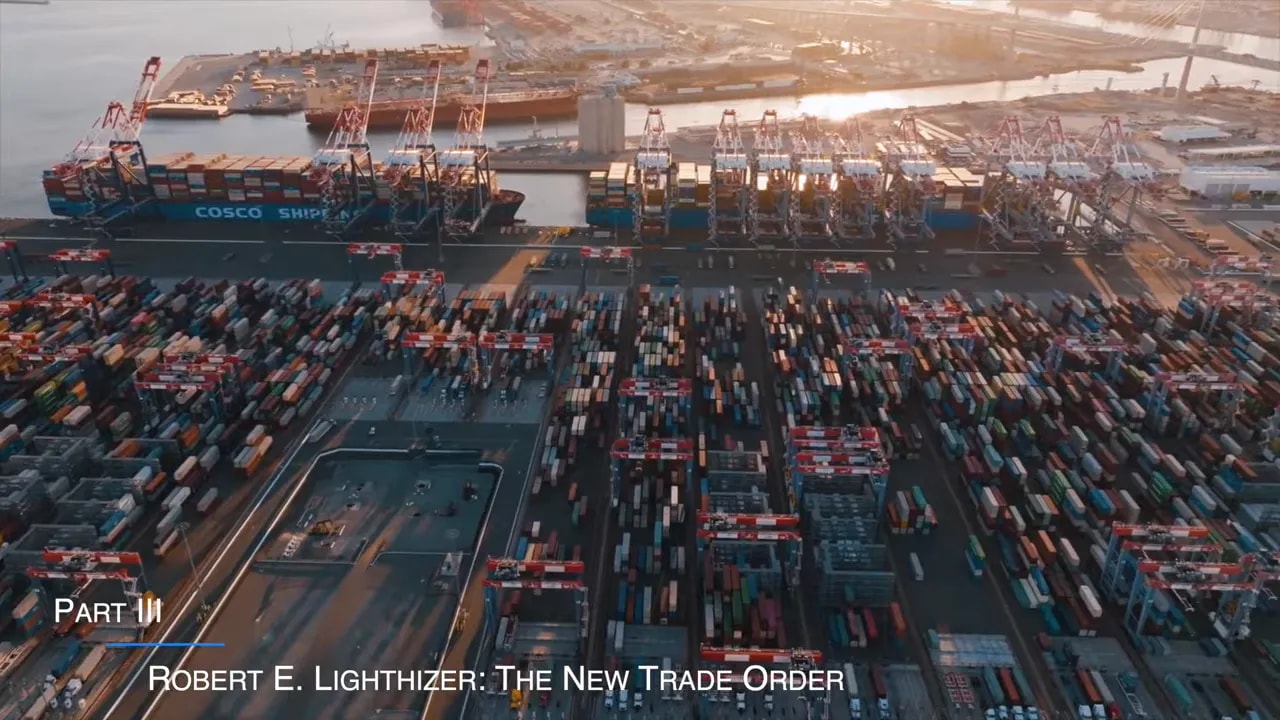
Lighthizer’s argument starts with the postwar system created at Bretton Woods. That framework was originally designed to support reconstruction, expand growth, and reduce conflict through economic cooperation. Over time, however, he argues that it evolved into a system that prioritized free trade while paying too little attention to structural imbalances.
His central complaint is that the United States tolerated persistent trade deficits and industrial decline for too long, partly because market access was seen as useful in sustaining Cold War alliances. In this telling, strategic generosity gradually turned into economic vulnerability.
China’s WTO entry as a turning point
Lighthizer identifies China’s entry into the World Trade Organization around 2000 as a major turning point. He argues that Beijing combined access to global markets with state-led industrial policy, subsidies, market restrictions, and support for state-owned enterprises.
In his view, that produced an uneven playing field. The consequences, he claims, included:
- Large transfers of wealth abroad
- Millions of lost U.S. manufacturing jobs
- Slower long-term American economic growth
- Rising skepticism toward globalization inside the United States
He also offered an anecdote illustrating how trade concerns evolve over time. In a 2019 meeting, senior Japanese officials reportedly showed him charts describing how China was using subsidies, currency practices, and state-linked firms to distort the free trade system. Lighthizer responded that he had used very similar charts in the 1980s to explain Japan’s behavior. The point was clear: trade tensions recur, but the scale and strategic significance of China make the current challenge more serious.
The case for “balanced trade”
Lighthizer argues that recent U.S. policy marks a break with the old consensus. He points to tariffs, industrial policy, supply chain resilience measures, and efforts to secure critical resources such as semiconductors and minerals.
At the center of his proposal is the idea of balanced trade. Rather than maximizing the free flow of goods and capital at almost any cost, countries would aim to maintain rough equilibrium in trade over time.
Under that concept:
- Countries with persistent surpluses would face higher tariffs
- Countries with balanced trade would enjoy lower barriers
- The system would discourage governments from shifting the costs of domestic policy onto trading partners
Whether or not one agrees with the approach, it reflects a broader shift in policy thinking. Trade is no longer treated solely as an efficiency question. It is now tied to resilience, national security, strategic industries, and domestic political stability.
That change is especially relevant to China. For decades, debates about trade with Beijing were often framed in terms of mutual benefit and market integration. Today, they are increasingly framed in terms of dependency, leverage, and risk.
The broader pattern across all three stories
These three developments may seem separate, but they are connected by a common logic.
First, the AI dispute shows that technological leadership is now treated as a strategic asset that must be defended. Second, the scam crackdown shows that transnational networks can become geopolitical issues when they involve cross-border coercion, criminal finance, and state reputation. Third, the trade debate shows that economic openness is being re-evaluated through the lens of national security and industrial policy.
The result is a harder international environment. Competition with China is not confined to one domain. It now plays out simultaneously in:
- Advanced technology
- Law enforcement cooperation
- Trade architecture
- Supply chains and industrial capacity
- Political narratives about fairness and power
That is the clearest takeaway from this round of China Update News. The central question is no longer whether strategic rivalry exists. It is how deeply it will reshape the rules of globalization itself.
FAQ
What is adversarial distillation in AI?
Adversarial distillation refers to using the outputs of advanced AI models to train smaller systems without authorization. Distillation itself is a normal machine learning technique, but U.S. officials argue it becomes problematic when used at scale to replicate proprietary capabilities and bypass commercial or geographic restrictions.
Why is the United States focusing on Chinese access to American AI models?
Washington sees frontier AI as both an economic and national security asset. The concern is that large-scale extraction of model behavior could allow competitors to reproduce advanced capabilities at lower cost, while also removing safety safeguards embedded in the original systems.
What are the scam compounds in Cambodia and Myanmar?
These are organized criminal centers involved in telecom fraud, fake investment schemes, and online scams. Many are also linked to human trafficking, with workers forced under abusive conditions to carry out fraud against victims around the world.
Why are China and Cambodia intensifying cooperation now?
The scam industry has become too visible and damaging to ignore. It affects victims internationally, harms Cambodia’s image, and has generated increasing political pressure on Beijing because many victims are Chinese and many networks have been associated with Chinese nationals.
What does Robert Lighthizer mean by a new trade order?
He argues that the world is moving away from unrestricted hyper-globalization toward a system centered on balanced trade, industrial policy, and national economic security. In that framework, persistent surplus countries could face higher barriers while more balanced relationships would be rewarded.
How do these stories fit together in China update news coverage?
They show a common shift toward strategic competition. AI access, criminal enforcement, and trade policy are all increasingly being treated as security issues, not just technical or commercial matters. That makes the relationship between China and other major powers more complex and more contested.
Final takeaway
The latest developments illustrate a world in transition. The AI dispute suggests that digital knowledge itself has become a strategic frontier. The Cambodia crackdown highlights how criminal networks can destabilize regional politics and expose governance failures. The trade debate shows that the age of simple globalization narratives is fading.
For policymakers, businesses, and analysts, the message is straightforward. China policy can no longer be separated neatly into economics, security, and diplomacy. Those categories are merging. And as they do, the global system is being reorganized around competition over technology, control, and resilience.
That is why this edition of China Update News matters well beyond the individual headlines. It captures a larger geopolitical shift already underway.