
China update news this week centers on three developments with implications far beyond China’s borders: allegations that authorities may be underreporting a serious foot-and-mouth disease outbreak, a new European business report warning that Beijing is turning export controls into a strategic economic weapon, and a major assessment of China’s high-tech progress that finds impressive gains alongside persistent weaknesses.
Taken together, these stories point to a common theme. China’s domestic governance, trade policy, and technology ambitions are becoming more consequential for global markets, supply chains, and strategic competition. Agriculture, critical minerals, semiconductors, pharmaceuticals, and industrial policy are no longer separate issues. They are increasingly linked.
Table of Contents
- News Section 1: Why the reported foot-and-mouth disease cases matter
- News Section 2: China’s export controls are becoming a strategic tool
- News Section 3: China’s tech rise is real, but it is not uniform
- What ties these three stories together
- Why this matters for the months ahead
- FAQ
News Section 1: Why the reported foot-and-mouth disease cases matter
China has confirmed outbreaks of foot-and-mouth disease in two widely separated locations, prompting concern that the problem could be larger than officially disclosed. The disease itself is not primarily feared because of its impact on humans. It is feared because it is one of the most contagious livestock diseases in the world and can quickly destabilize food production systems.
Foot-and-mouth disease affects cloven-hoofed animals including:
Cattle
Pigs
Sheep
Goats
Infected animals can develop fever, painful blisters in the mouth and on the feet, lameness, and sharp declines in productivity. Adult animals often survive, but young livestock can die in significant numbers. Even where mortality is limited, the economic damage can be severe because infected herds lose value rapidly and authorities often respond with mass culling.
The disease spreads through the air, contaminated equipment, and the movement of animals. That makes containment difficult once an outbreak has escaped local control. It also means that any delay in reporting can dramatically worsen the final cost.

What has been confirmed
China’s Ministry of Agriculture confirmed on March 28 that outbreaks had occurred in Yining County in Xinjiang and in Gulang County in Gansu. These locations are roughly 2,400 kilometers apart. Officially reported cases involved dozens of infected cattle.
That alone would already be significant. But the official disclosure reportedly omitted key details, including when the outbreaks began. For disease surveillance, timing matters almost as much as geography. Without a clear timeline, it becomes difficult to judge whether the virus was detected early or whether transmission had been occurring for some time before the announcement.
Why analysts are skeptical
Several features of the case have triggered suspicion that the outbreak could be broader than acknowledged.
The distance between the confirmed outbreak sites suggests that isolated local transmission may not fully explain the pattern.
The strain involved, SAT1, is particularly concerning because existing vaccines in China reportedly do not protect against it.
Emergency approval of new vaccine production and distribution in multiple provinces indicate a response that may exceed the scale implied by the official case numbers.
None of this proves a cover-up. But it does raise a reasonable question: if the outbreak were truly narrow and well contained, why was such a broad emergency response needed so quickly?
The shadow of African swine fever
Much of the concern comes from precedent. In 2018, African swine fever spread through China with devastating consequences for the pork industry. Later assessments, including those referenced in international reporting, suggested the disease had circulated for months before being fully acknowledged. Early reporting was geographically inconsistent, and that likely complicated containment efforts.
A large foot-and-mouth outbreak could be even more disruptive because it would threaten multiple livestock sectors at once. Pork, beef, and dairy could all face pressure simultaneously.
The implications would include:
Losses for farmers and agribusiness
Livestock culling on a large scale
Higher domestic food prices
Strain on food security
Potential import surges that affect global markets

Why food inflation is politically sensitive
In China, food prices are not just an economic issue. They are politically sensitive. Sharp increases in meat, dairy, and staple food costs can generate public dissatisfaction quickly, especially in urban areas. That is one reason disease control in agriculture matters far beyond the farm sector.
If the outbreak remains contained, the damage may be limited. If reporting is incomplete and transmission is wider than admitted, the consequences could spread through the entire food system. Global agricultural trade would also feel the impact because China is a major importer of agricultural products. A sudden increase in import demand or changes in trade flows could tighten international supply and increase volatility in already uncertain commodity markets.
The core risk: delayed or incomplete reporting
The most serious danger in outbreaks like this is not only the disease itself. It is miscalculation. If authorities underestimate spread, they may deploy the wrong containment measures, move too slowly, or fail to impose restrictions where needed. By the time the full scale becomes clear, a manageable problem can turn into a national agricultural shock.
There is still a plausible alternative explanation: Beijing may have learned from earlier failures, and the official disclosures so far may be broadly accurate. If that is the case, then emergency vaccine production and regional responses are signs of competence rather than concealment. The next several weeks will be decisive.
News Section 2: China’s export controls are becoming a strategic tool
The second major development comes from a new report by the European Union Chamber of Commerce in China. Its central argument is that Beijing has rapidly expanded export controls and transformed them from a narrow security instrument into a broader tool of economic statecraft.
This is a significant claim because export controls used to be discussed mainly in the context of non-proliferation or national security. Now they are increasingly tied to supply-chain leverage, industrial competition, and geopolitical pressure.
A sharp increase in controls
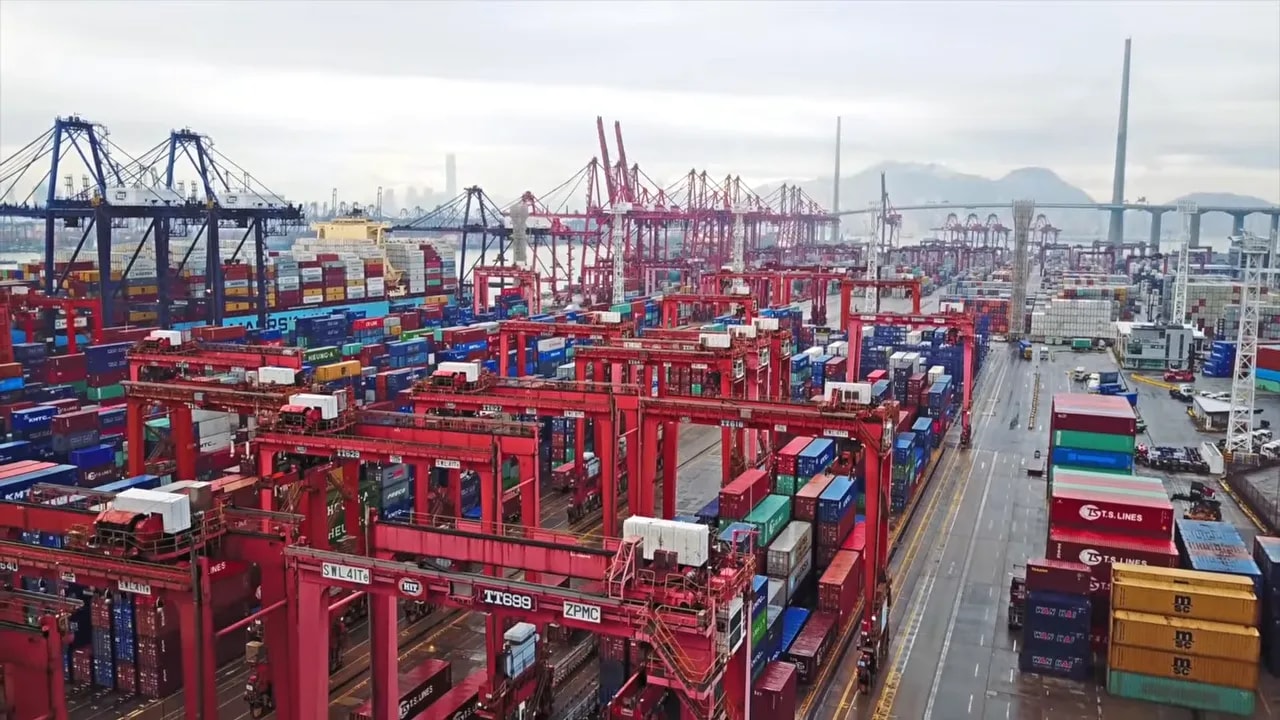
According to the report, China introduced around 30 export control measures between 2021 and 2025. That is nearly triple the number introduced during the previous five-year period.
The measures reportedly concentrate on areas where China holds strong market power, especially in parts of the critical minerals and rare earth supply chain. In practice, that means Beijing is positioning itself to influence sectors that other advanced economies consider strategic, including clean energy, electronics, defense manufacturing, and advanced industrial production.
More than national security
The report argues that many of these controls are geo-economic rather than purely security driven. In other words, they are designed not only to prevent sensitive technologies from flowing outward, but also to shape the choices of foreign governments and firms through economic dependence.
This fits with China’s broader dual circulation strategy. That framework aims to strengthen domestic supply chains while keeping foreign firms tied to China’s manufacturing ecosystem. The logic is straightforward:
Reduce vulnerability to external pressure.
Preserve and deepen foreign dependence on Chinese industrial capacity.
Use regulatory tools to discourage rapid diversification away from China.
Recent regulations, including rules aimed at countering what China calls foreign improper extraterritorial jurisdiction, appear to reinforce this direction. Such measures can make it harder for multinational firms to relocate sourcing or production without facing legal and regulatory friction.
Why foreign businesses are concerned
For businesses, the issue is not just that export controls exist. Many governments use them. The concern is the combination of scale, opacity, and breadth.
Business groups in China have warned that excessive use of these tools could undermine confidence in China as a dependable supplier. A company building long-term supply chains needs predictability. If access to critical inputs can be tightened quickly and with limited consultation, firms are more likely to accelerate de-risking strategies.
That response is already visible in Europe. Policymakers there are moving to reduce reliance on Chinese supply chains, including through initiatives such as joint procurement arrangements for critical minerals. The urgency is especially strong in rare earths, where China is estimated to control as much as 90 percent of output.

A broader trend toward trade fragmentation
One of the report’s most important conclusions is that the world economy is moving toward fragmentation. China is not the only major power using trade and technology restrictions for strategic ends. The United States and its allies have also tightened restrictions in recent years. But the report argues that China’s framework is more comprehensive, deeper, and in many respects longer-running.
The practical outcome is a more politicized trading environment where commercial decisions increasingly overlap with national strategy. For firms operating across borders, this means:
Higher compliance costs
More uncertainty in sourcing decisions
Greater exposure to sudden policy shifts
Pressure to choose between competing regulatory systems
For governments, the danger is a race to the bottom in which every side adds new restrictions, reducing efficiency and increasing strategic mistrust.
News Section 3: China’s tech rise is real, but it is not uniform
The third major item in this round of China update news is a report from the Center for Strategic and International Studies by Scott Kennedy. Its central finding is nuanced: China’s rise in advanced technology is undeniable, but it is highly uneven and constrained by structural weaknesses.
This matters because debate about China’s technological future often swings between extremes. One side assumes China is on the verge of dominance across all strategic sectors. The other assumes the system’s inefficiencies will eventually prevent serious competition. The report lands in the middle. China has achieved major progress, but not everywhere, and not without limits.
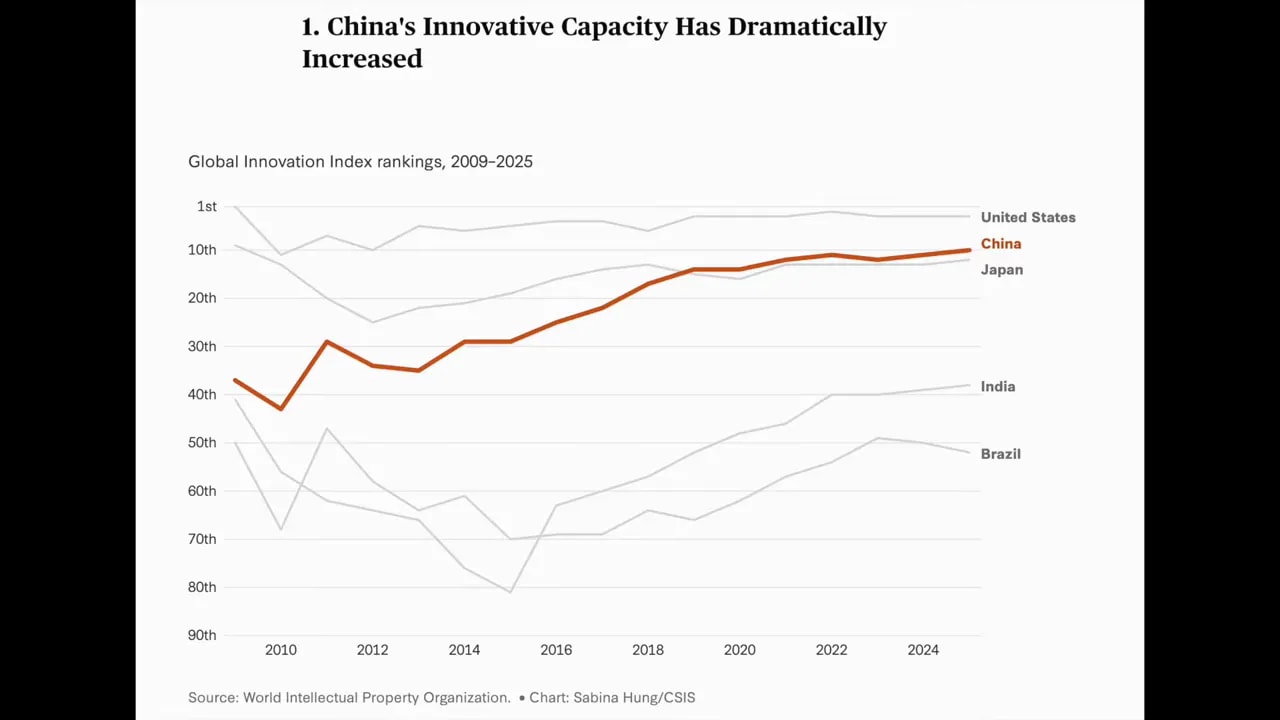
1. Innovation capacity has risen dramatically
China now ranks among the top 10 globally in the Global Innovation Index. That reflects long-term investment in education, infrastructure, and research systems. It also reflects the ability of Chinese firms to scale products rapidly in a very large domestic market.
An important point in the analysis is that not all innovation gains were purely state-led. In many cases, private firms succeeded first and state support followed.
2. Research and development spending is enormous
China’s R&D spending has climbed from modest levels in the early 2000s to more than $1 trillion, slightly surpassing the United States in headline terms. That is a major symbolic and practical milestone.
But composition matters. China’s spending is more state driven, while the US model relies more heavily on private-sector investment. That may affect efficiency, flexibility, and the quality of resource allocation.
3. Strong outputs do not erase institutional weaknesses
China performs well on outputs such as patents, infrastructure, and deployment of technology. Yet the country still lags in institutional quality, including:
Rule of law
Regulatory transparency
Financial market development
Venture capital depth and openness
These institutional gaps may become more important over time, especially as innovation shifts from scaling known technologies to creating genuinely new ones.
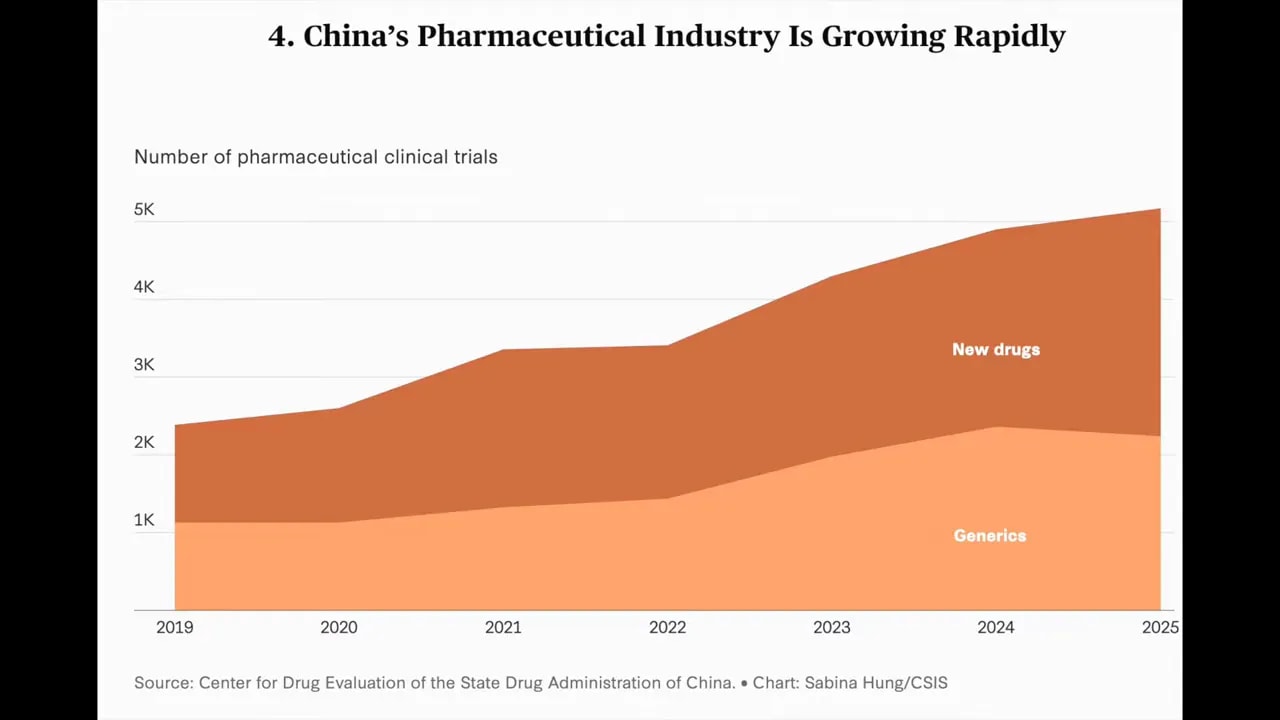
4. Pharmaceuticals are a standout sector
One of the report’s more surprising findings is the strength of China’s pharmaceutical sector. It now accounts for roughly 30 percent of new innovative drugs, according to the report’s framing. This growth is linked in part to returnee scientists trained in Western systems who brought back both research expertise and regulatory know-how.
The surge in clinical trials suggests that this is not a narrow success but part of a broader increase in scientific and commercial sophistication.
5. Commercial aviation remains weak
In contrast, commercial aviation remains a difficult sector for China. The C919 passenger jet is a notable national project, but production has been slow and the aircraft still relies heavily on foreign components. Aerospace manufacturing requires exceptionally complex supply chains, strict certification, and deep engineering experience. Those barriers remain high.
The result is that China is unlikely to challenge Airbus and Boeing at the top end in the near term.
6. Semiconductor progress is real, but limited
China has made progress in lower-end chipmaking, materials, and packaging. However, the report argues that dependence on foreign firms remains substantial in advanced semiconductors and key manufacturing equipment.
This is one of the clearest examples of uneven development. Heavy investment has produced gains, but full self-reliance, especially at the cutting edge, still appears unlikely in the near future.
7. Military-civil fusion may be overstated
One of the report’s more controversial points is that China’s military-civil fusion strategy receives relatively modest direct funding compared with wider industrial and military budgets. That does not mean the concept is irrelevant. It means some Western discussions may exaggerate its centrality relative to other drivers of technological development.
8. Private firms matter in defense AI
Another notable conclusion is that AI-related defense contracts often go to commercial firms rather than state-owned enterprises. This highlights the role of the private tech ecosystem in military modernization. At the same time, the distinction between private and state is less clear in China than in many other economies, given the state’s deep influence over major sectors.
9. China is gaining influence in global standards
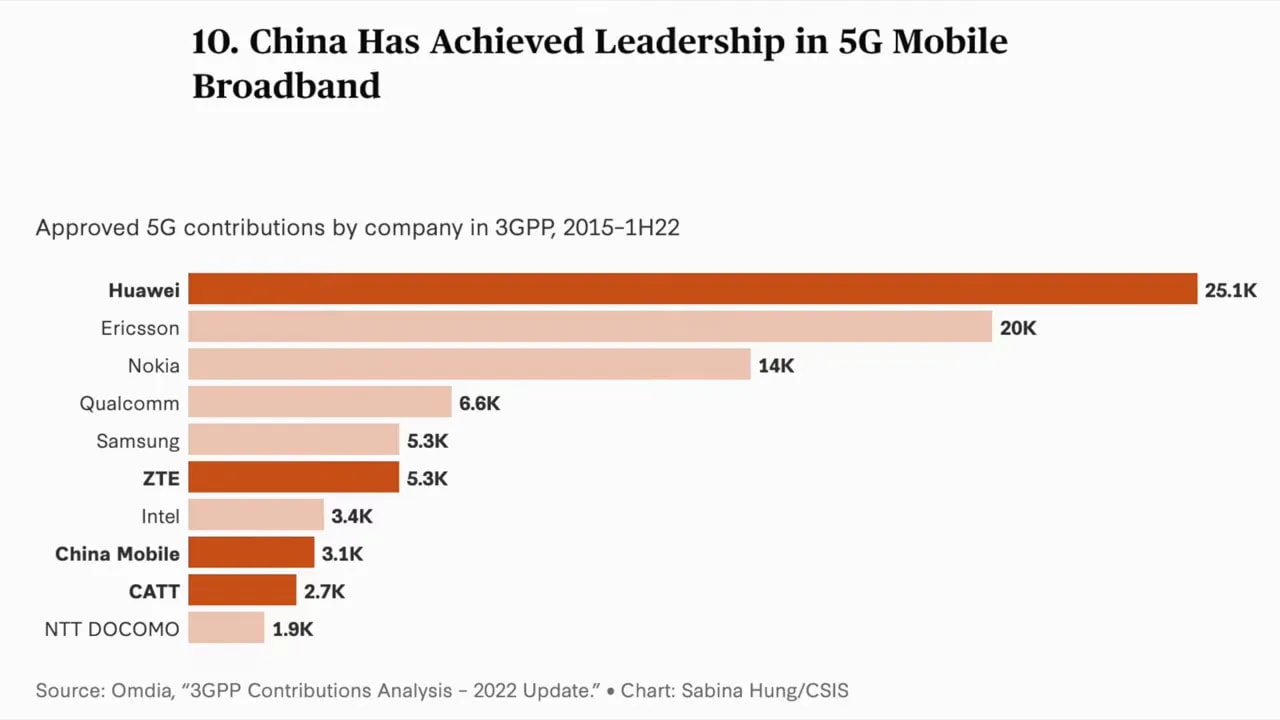
Chinese companies and researchers are taking more leadership roles in international standards-setting bodies such as 3GPP. This matters because standards shape the rules of future technology ecosystems. Influence at that level can deliver long-term strategic advantages even without total market dominance.
10. China leads in 5G participation and scale
China has become a major force in 5G development, with companies like Huawei playing leading roles in standards contributions. Western firms still control some underlying technologies, but China’s scale and active participation give it significant leverage over how next-generation communications systems develop.
What ties these three stories together
The outbreak allegations, the export control strategy, and the technology assessment may seem unrelated at first. In fact, they reveal different dimensions of the same underlying reality: China’s choices are having wider and more immediate global effects.
In agriculture, transparency and rapid reporting determine whether a livestock disease remains local or becomes an international market shock.
In trade, export controls are no longer technical legal tools. They are becoming instruments for shaping dependence and strategic behavior.
In technology, China is no longer simply catching up. It is already a leading power in some fields, a weak challenger in others, and structurally constrained in ways that policymakers on all sides must understand clearly.
The broader lesson is that simplistic narratives are increasingly unhelpful. China is not uniformly dominant, nor is it easily decoupled from. It is deeply embedded in global systems, but those systems are becoming more contested and more political.
Why this matters for the months ahead
Three questions will be especially important to track.
Will China provide fuller transparency on the foot-and-mouth disease outbreak? If more provinces begin responding aggressively or if trade disruptions appear, that may indicate a larger problem.
Will export controls trigger faster de-risking by Europe and other economies? Business confidence can erode gradually, then shift quickly.
Can China turn technological advances into durable leadership? Progress in pharmaceuticals and 5G is real, but weak institutions and dependence on foreign inputs still matter.
For policymakers, investors, manufacturers, and analysts, these are not separate developments. They are connected parts of a world in which China’s internal management, legal tools, and industrial ambitions increasingly shape external outcomes. That is the central takeaway from this week’s China update news.
FAQ
What is foot-and-mouth disease and why is it serious?
Foot-and-mouth disease is a highly contagious viral disease affecting livestock such as cattle, pigs, sheep, and goats. It spreads quickly through air, equipment, and animal movement. Even when adult animals survive, outbreaks can trigger mass culling, major production losses, and trade disruptions.
Why are there concerns about underreporting in China’s outbreak?
The confirmed outbreak sites are far apart, the strain involved is not covered by existing vaccines, and emergency vaccine production has reportedly already been approved for wider distribution. Those facts have led some analysts to suspect broader transmission than officially disclosed.
How could a larger livestock outbreak affect global markets?
A wider outbreak could raise food prices inside China, disrupt pork, beef, and dairy production, and alter China’s agricultural import demand. Because China is a major food importer, that could tighten global supply and increase price volatility.
What is changing in China’s export control policy?
Export controls are increasingly being used not only for traditional security purposes but also as tools of economic leverage. They now play a larger role in shaping supply chains, especially in sectors such as rare earths and critical minerals where China holds strong market positions.
Is China becoming a global technology leader?
Yes, in some sectors. China has made major advances in innovation capacity, R&D spending, pharmaceuticals, 5G, and standards setting. But progress is uneven. Commercial aviation and advanced semiconductors remain areas of weakness, and institutional limits could slow future gains.
What is the main lesson from this round of China update news?
The main lesson is that China’s domestic decisions are increasingly global in effect. Disease reporting, export controls, and industrial policy now influence food markets, supply chains, and strategic competition well beyond China itself.