
China Update News is dominated by three themes right now: contested cyber intelligence, a fragile Middle East ceasefire with global spillovers, and a quieter but important economic shift toward electrification in shipping. Add to that a new Southeast Asia sentiment signal that ASEAN elites increasingly prefer China to the United States when forced to choose, and you get a week where technology, security, and trade all move together.

Table of Contents
- 1) Alleged Massive Cyber Attack on China’s Tianjin Supercomputing Center
- 2) Iran Ceasefire Developments: Beijing’s Role, Washington’s Tariff Threats, and Strait of Hormuz Leverage
- 3) CATL’s Push Into Maritime Electrification: Batteries Beyond Land
- 4) ASEAN Sentiment Shift: Opinion Elites Choose China Over the US (But With Narrow Margins)
- FAQ
- Bottom Line
1) Alleged Massive Cyber Attack on China’s Tianjin Supercomputing Center
Reports of a massive cyber attack tied to China’s National Supercomputing Center in Tianjin have drawn international attention, though critical details remain uncertain. The center is located in Tianjin, a coastal port city, and serves as a high-stakes computing hub supporting thousands of clients.
What is being claimed
According to reporting summarized in China Update News, an individual using the pseudonym “flaming China” claims to have extracted more than 10 petabytes of sensitive data from the facility. If the claim holds up, it would be among the largest data breaches in history.
The alleged dataset is said to include a wide range of materials, including technical reports and simulation data, as well as highly sensitive defense-related files. Some samples reportedly reference advanced weapon simulations, including modeling of:
- Missile systems
- Bunker-busting munitions
- Platforms such as HIMARS and aircraft carriers
One detail that intensifies concerns is the alleged recency of some documents, reportedly dating as recently as 2024 and 2025. That matters because strategic value increases when the data reflects current or near-current capabilities and assumptions.
How the breach is said to have happened
The breach claims describe a specific access path: a compromised VPN domain controller, followed by exfiltration over roughly six months. The actor also claims a distributed botnet was used both to extract and store data, enabling ongoing access and redundancy.
In other words, the narrative is not a one-off intrusion. It is an extended campaign with operational infrastructure, which is exactly the kind of scenario that can be especially damaging when the target is a computing center supporting defense-adjacent and research workloads.
Why verification is hard
Even with technical-sounding details, skepticism remains. Analysts familiar with China’s cyber environment caution that incidents like this can be difficult to verify, and that some breach narratives may be influenced by disinformation or exaggeration.
Another unresolved question is whether the data was actually sold. Negotiations are reportedly ongoing with multiple parties, but experts note that if a breach was real and as extensive as described, data actors would likely already have secured access to the full dataset.
China Update News takeaway: the incident highlights both the growing geopolitical importance of cyber capabilities and the increasing challenge of distinguishing genuine signal from noise in the digital domain. High-performance computing infrastructure is inherently strategic, which makes it simultaneously more valuable and more vulnerable.
2) Iran Ceasefire Developments: Beijing’s Role, Washington’s Tariff Threats, and Strait of Hormuz Leverage
A fragile ceasefire in the Iran-related conflict appears to be taking hold, but early reporting suggests violations and ongoing leverage dynamics. The diplomacy and the security posture are moving together, and China’s position remains central mostly through economic ties and “behind-the-scenes” engagement rather than visible security ownership.
China’s involvement remains ambiguous
Speaking to AFP, US President Donald Trump indicated that Beijing had helped bring Iran to the negotiating table, saying, in substance, “I hear yes” when asked about China’s involvement.
Chinese officials, however, have not provided public clarification on what role, if any, they played in securing the truce. This kind of ambiguity fits a broader pattern often discussed in China Update News coverage: active engagement behind the scenes, paired with limited overt claims of political ownership.
US rhetoric escalates, complicating US-China relations
At the same time, the US president escalated rhetoric that could complicate already strained US-China relations. In a social media post, he warned that any country supplying military equipment to Iran would face immediate 50% tariffs on exports to the United States.
US-based Politico reporting notes that the legal basis for such tariffs remains uncertain. Still, mechanisms linked to earlier trade investigations targeting China could potentially be used. The sensitivity here is obvious: long-standing concerns exist about Chinese support for Iran’s military capabilities.
Dual-use concerns and missile-related reporting
Reuters cited reporting indicating that Tehran has explored purchasing Chinese anti-ship cruise missiles. Other assessments suggest Beijing provides dual-use technologies, including components that can be used for drones.
This places China in a delicate position. It is economically engaged with Iran, but it is wary of being drawn into regional security commitments that could carry major strategic and reputational costs.
Security guarantor expectations are pushed back
One reason the ceasefire narrative matters beyond the immediate conflict is that it prompts questions about what China is willing and able to do. Chinese analysts, according to the South China Morning Post, have pushed back against suggestions that China could act as a security guarantor in the Middle East.
Meanwhile, Iranian officials publicly express hope for greater involvement. The gap between those positions reflects a consistent theme: Beijing prioritizes stability and economic access over getting directly “hands on” in security arrangements.
Ceasefire holding does not mean normal shipping
Even if fighting pauses, the commercial and security environment in the region has not returned to normal. The Wall Street Journal reported that Iran continues to exercise tight control over the Strait of Hormuz, with shipping traffic sharply reduced.
Ships reportedly must coordinate with the Islamic Revolutionary Guard Corps and pay transit fees using currencies such as the Chinese yuan or even cryptocurrency.
That detail matters because it underscores Tehran’s leverage and highlights evolving financial dynamics. It also raises the possibility of greater Chinese entanglement, whether intentionally or not, as payments and coordination channels form around current realities.
Why Gulf Arab states may see China as “transactional”
For Gulf Arab states, China’s role is often viewed through a pragmatic lens. Regional experts cited in China Update News reporting describe Beijing as deeply engaged economically but reluctant to translate that influence into meaningful political or security commitments.
Even with the Belt and Road Initiative strengthening ties, the argument goes that Beijing does not necessarily have decisive diplomatic leverage strong enough to guarantee security outcomes.
What happens next depends on Washington-Beijing-regional power dynamics
The ceasefire can either consolidate or unravel. In either case, the interplay between the United States, China, and regional actors will be critical. The Iran conflict is not only a regional security issue. It is also a testing ground for how great power influence is exercised and resisted.
One Chinese analyst, O. Xinbo of Fuldan University’s Center for American Studies, argued that the conflict has been a serious setback for Trump and suggested Beijing may have to play an even larger role. But another veteran China analyst, Bill Bishop, pushed back with a broad skepticism about overconfident external-propaganda claims.
3) CATL’s Push Into Maritime Electrification: Batteries Beyond Land
One of the more forward-looking developments in this week’s China Update News is an industrial move with long-term implications: battery giant CATL is stepping up efforts to electrify parts of the global shipping industry.

Replicating EV dominance on the high seas
CATL already holds roughly 37% of the EV battery market. The company has deployed battery systems on about 900 vessels, mostly smaller ships operating along China’s coastline, rivers, and ports.
The new push is meant to extend battery electrification from smaller near-shore operations toward wider maritime applications. That aligns with Beijing’s decarbonization goals and with growing pressure on shipping to cut emissions.
Why shipping decarbonization is accelerating
Global shipping emissions are currently about 3% of the total. The International Maritime Organization’s target is to cut shipping emissions by half by 2050.
Batteries are being positioned as one pathway, particularly for near-shore vessels. Other alternative fuels under development include green methanol and hydrogen.
Geopolitical shocks have added urgency. Disruptions to energy supply chains in the Middle East, and the closure or heightened risk around the Strait of Hormuz, have reinforced the need to reduce reliance on fossil fuels.
Analysts, including those at Bernstein, argue these events are helping accelerate a broader global electrification trend. CATL is investing heavily in maritime systems, including plans to double its maritime division to around 500 employees.
Battery swapping and the economics problem
CATL is also exploring battery-swapping systems for ships, mirroring infrastructure it has built for electric trucks. The logic is to reduce upfront vessel costs and improve operational efficiency by making battery replacement faster and more standardized.
Still, challenges are real. Battery-powered maritime systems are currently more expensive than traditional maritime fuels, and the energy density limits their use in long-distance shipping. For longer routes, a hybrid approach combining batteries with conventional engines is described as more viable in the current market.
CATL’s confidence rests on the expectation that battery costs will keep falling and that policy support will strengthen. It is, essentially, a bet that economics and regulation will eventually catch up with the technology.
4) ASEAN Sentiment Shift: Opinion Elites Choose China Over the US (But With Narrow Margins)
The last major development in this set of China Update News themes is not about a battlefield or a hacked server. It is about sentiment and perceived risk among Southeast Asia elites.
A new survey shows a subtle reversal
The annual State of Southeast Asia report, published by the ISEAS Yusuf Eshak Institute in Singapore, provides a snapshot of how ASEAN policymakers, academics, and business figures respond to a forced-choice scenario.
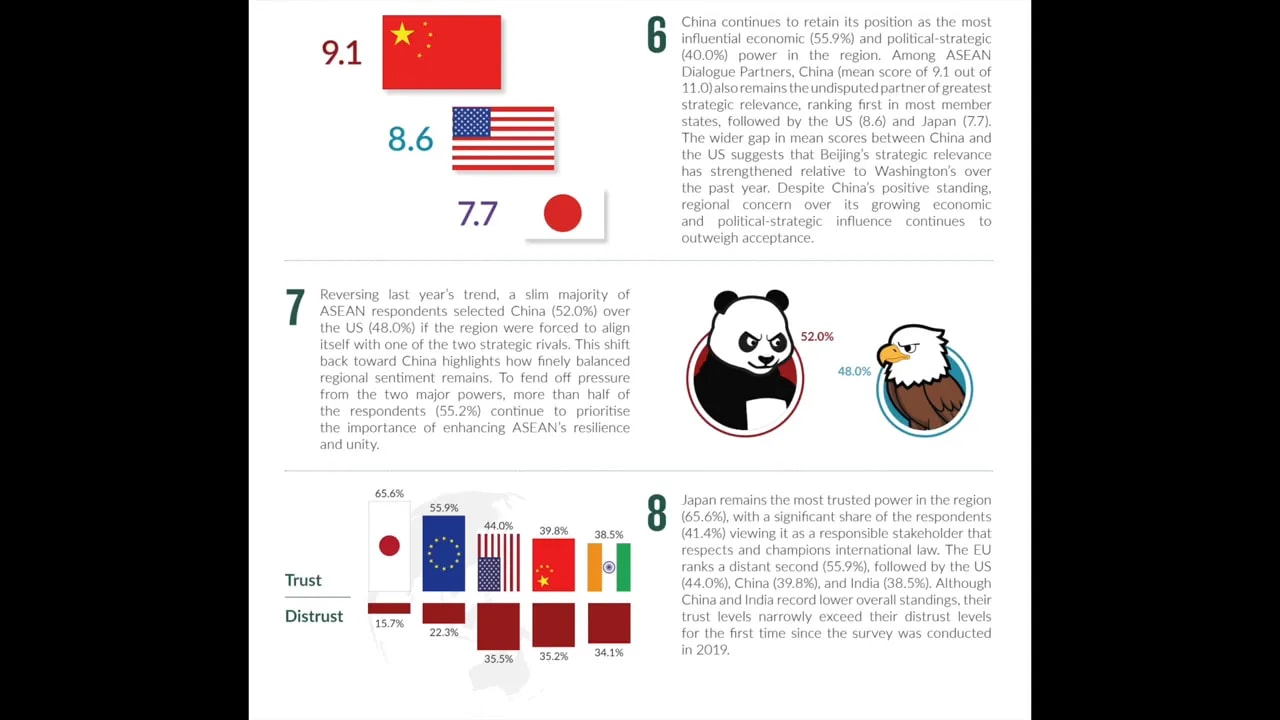
In this year’s results, 52% would choose to align with China if forced to pick between China and the United States, compared with 48% choosing the US. The direction is described as a reversal from 2025, when the United States briefly regained its position as the region’s preferred partner.
The margin is narrow. But the direction matters because it suggests increasing unease about Washington’s role in the region.
Leadership uncertainty in Washington becomes a top concern
More than half of respondents, 51.9%, identified US leadership as their top geopolitical concern. This surpassed even long-standing regional tensions such as South China Sea disputes.
That is a significant shift in priorities: political uncertainty in Washington is seen as more immediate risk than China’s assertiveness.
Other concerns reflect a world where globalization feels messy
The survey also highlights:
- Rise of global scam operations (51.4%)
- Ongoing maritime tensions (48.2%)
- Regional conflicts such as a Cambodia-Thailand border dispute ranked lower
This reinforces the idea that global dynamics are shaping Southeast Asia’s strategic outlook more directly than local disputes alone.
An ironic twist: negative views coexist with American media consumption
One of the more interesting observations in China Update News reporting is that although elites hold more negative views of the United States, they reportedly consume American media heavily. Meanwhile, they consume very little from China.
So, at least in part, criticism of the US may be driven by American media itself. It is an ironic soft-power reality: negative sentiment does not necessarily mean reduced informational influence.
What “choosing China” really means
The key interpretive point is that this is not necessarily about alliance-building. For ASEAN countries, the choice appears to be less about commitment to a bloc and more about navigating uncertainty.
Right now, China is perceived as offering a steadier hand. That could change quickly, however. The report logic suggests that a security crisis in the South China Sea or East China Sea from Beijing could cause elites to return to the United States as a security guarantor.
There is also a practical economic factor: even during the trade war last year, some elites may not have been happy with Washington, but the American market remains larger than China’s.
FAQ
What is the biggest claim in the reported cyberattack on Tianjin?
The central claim is that a hacker using the pseudonym “flaming China” extracted more than 10 petabytes of sensitive data from China’s National Supercomputing Center in Tianjin, which would be among the largest breaches in history if verified.
Why are analysts skeptical about the breach narrative?
Verification is difficult in cyber incidents, and analysts have noted that disinformation or exaggerated breach accounts can circulate. Experts also question whether the data was truly sold and fully accessible given the claimed scale.
What role did China appear to play in Iran ceasefire diplomacy?
US President Donald Trump suggested Beijing helped bring Iran to negotiations, but Chinese officials have not publicly clarified their role. This reflects a pattern of engagement without clear public ownership.
How does maritime electrification connect to the geopolitical situation?
Shipping decarbonization is driven by policy targets, but geopolitical shocks, including Middle East disruptions and Strait of Hormuz risks, increase urgency to reduce reliance on fossil fuels. CATL’s move into maritime electrification is positioned within that broader trend.
What did the Southeast Asia survey say about alignment preferences?
According to the ISEAS Yusuf Eshak Institute’s State of Southeast Asia report, 52% of ASEAN elites would choose to align with China if forced to choose between China and the United States, compared with 48% for the US. The shift is narrow but indicates growing unease about Washington.
Bottom Line
This edition of China Update News reads like a map of where power is contested and where uncertainty is growing. Cyber intelligence remains opaque but potentially consequential. Middle East diplomacy is fragile, and economic ties intersect with security leverage in critical waterways. Meanwhile, industrial decarbonization efforts like CATL’s maritime electrification show how long-term economic strategy keeps moving even amid short-term crises. Finally, ASEAN sentiment hints that many regional elites are seeking predictability, not just ideological alignment, and that choice could swing quickly with security events.
Note: Some reported claims, particularly in cybersecurity, may not be fully verifiable yet. It remains important to treat extraordinary figures with caution until independent confirmation becomes available.