
China Update News this week spans four themes that connect domestic demand, cross-strait politics, online information integrity, and global health R&D. Official data points to travel rebounding, but spending per person edging down. Meanwhile, high-level engagement across the Taiwan Strait is framed in symbolic language, even as political divisions and deterrence debates persist. Separate reporting also describes a shift in China’s “troll army” model toward platform-driven profit. Finally, major drugmakers are increasingly licensing and investing in Chinese biotech innovation, driven by pipeline pressure and faster trial timelines.

Table of Contents
- 1) Qingming Festival: More Trips, Slightly Less Spend Per Person
- 2) Taiwan Strait: Xi and KMT’s Cheng Li-wen Meet in Beijing, While Deep Divisions Persist
- 3) Taiwan’s Exports Break Records as AI Chip Demand Holds Up
- 4) China’s “Troll Army” Model Mutates: From Paid Smears to Platform Profit Incentives
- 5) Big Pharma Moves Toward China: Licenses, Trials, and the Search for Next-Generation Medicines
- What to Watch Next
- FAQ
1) Qingming Festival: More Trips, Slightly Less Spend Per Person
On the surface, China’s Qingming Festival holiday (a three-day public break) suggests a healthy recovery in mobility and activity. Official figures cited in recent reporting show that total trips during the holiday rose 6.8% year-on-year to 130 million. Yet a smaller, more telling signal is embedded in consumer behavior: per capita daily spending fell slightly, to 151.52 yuan from 152.24 yuan a year earlier.
The difference is modest, but it matters because it describes how households are responding rather than only how often they are going out. A headline rebound in travel volume can hide slower growth in discretionary spending, which often drives broader economic activity across retail, dining, and entertainment.
Why total trips rose faster than spending intensity
The data reflects a larger holiday window shaped by school breaks, which increased travel among families and younger travelers. The reporting also highlights stronger growth in longer-distance travel and in bookings involving teenage travelers traveling with families. This is consistent with pent-up demand for experiences after prolonged periods of reduced movement.
But the per-person spending decline implies consumers remain price sensitive. Rather than returning to a pattern of stronger discretionary spending growth, households appear to be managing budgets by spending a little less per trip while still traveling more.
Travel as a proxy for consumer strength
Travel periods are frequently treated as a useful proxy for broader consumption because they directly feed spending across services and local commerce. In this case, the slight pullback in spending per traveler suggests weaker multiplier effects for sectors that benefit from richer holiday spending.
The article further connects the holiday dynamics to market performance: box office revenue during the same period reportedly declined by 19% year-on-year. Together, these signals point to the same basic pattern: consumers are reallocating limited discretionary budgets instead of expanding them.
What this means for the “consumption problem”
The takeaway is not that travel collapsed. Instead, it reinforces a longer-running challenge: even as China works to strengthen domestic consumption, the economy is still not showing robust “spending intensity” growth. Higher volumes without stronger spending can limit how far consumption growth lifts the wider economy.
2) Taiwan Strait: Xi and KMT’s Cheng Li-wen Meet in Beijing, While Deep Divisions Persist
Cross-strait politics remain a major driver of strategic risk. This week included a high-profile meeting in Beijing involving Cheng Li-wen, leader of Taiwan’s main opposition KMT. The encounter was described as highly symbolic because it brought a senior Chinese Communist Party leader and a KMT figure together in a setting designed to convey state-level messages.
During the meeting, Xi Jinping reiterated Beijing’s position that Taiwan is part of China. He also warned against what was characterized as “external interference”, a phrase widely read as a reference to the United States. The rhetoric emphasized that cross-strait relations should remain in the hands of Chinese people, and it also stressed that moves toward Taiwanese independence would not be tolerated.
Cheng echoed messaging about avoiding the Taiwan Strait becoming a geopolitical flashpoint or a chessboard for outside powers. In the optics of a new engagement channel, the visit was described as rare: a high-level exchange between the Chinese Communist Party and the KMT, which retreated to Taiwan after losing the Chinese Civil War in the 1940s.
No formal breakthrough, but the optics are politically consequential
Reporting indicates Cheng was received with prominent symbolism and that she described being receptive to a proposal for a more institutionalized cross-strait dialogue mechanism. However, the same account notes that no concrete agreements were announced.
That matters because a meeting can signal willingness to talk while leaving core structural disagreements untouched. Even with institutional language, the larger political landscape remains divided inside Taiwan.
Inside Taiwan: DPP vs. KMT, and the question of independence
The reporting underscores that Taiwan’s political divisions run deep. The ruling Democratic Progressive Party (DPP), led by President William Lai Ching-te, has rejected Beijing’s preconditions for talks, maintaining that Taiwan is effectively independent.
In contrast, the KMT favors closer engagement with Beijing and opposes formal independence. Yet the reporting also clarifies a key constraint: the KMT does not openly support unification under Beijing’s control.
Deterrence spending and external scrutiny
Cheng’s outreach has drawn scrutiny in Taipei and Washington. One focal point is the KMT’s stance regarding a proposed $40 billion US defense budget aimed at strengthening Taiwan’s deterrence capabilities. Critics argue the trip could reinforce Beijing’s narrative that Taiwan is internally divided, while supporters frame it as a pragmatic way to reduce tensions.
Analysts: the core situation is unchanged
Analysts cited in the reporting suggest structural differences remain. Public opinion in Taiwan reportedly continues to show limited support for unification, and earlier engagement efforts similarly did not shift the political trajectory. A quote attributed to Drew Thompson, described as a senior fellow in Singapore and a former U.S. defense official responsible for China and Taiwan, argued that Cheng’s position does not represent the majority view in Taiwan. He emphasized that the source of military threats is not coming from the DPP or President Lai, but from Beijing.
With local elections approaching and a presidential race looming in 2028, political reverberations from the Beijing visit are expected to persist across domestic and international arenas.
3) Taiwan’s Exports Break Records as AI Chip Demand Holds Up
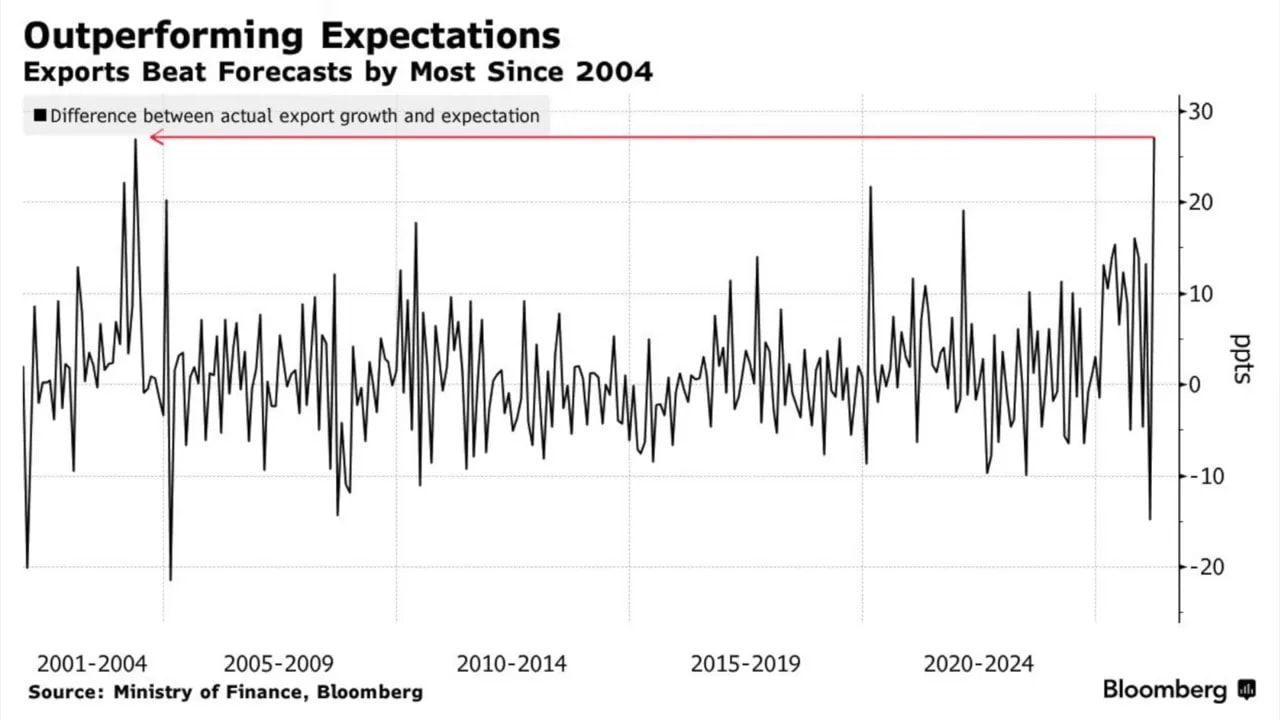
While diplomatic engagement and military-deterrence debates continue, economic indicators add another layer. Separate reporting highlights that Taiwan’s exports surged to a record high in March, driven largely by resilience in global demand for AI-related technologies.
Overseas shipments reportedly jumped nearly 62% year-on-year to $80.2 billion, surpassing expectations and marking Taiwan’s strongest monthly export performance on record. Taiwan’s Ministry of Finance attributed the surge to booming demand for AI-related technologies.
Semiconductor earnings reinforce the AI “insulation” argument
The export data coincided with strong earnings from Taiwan Semiconductor Manufacturing Co. (TSMC), which reported a 35% rise in quarterly revenue. The reporting interprets this as evidence that the AI boom remains largely insulated from disruptions linked to the US-Iran conflict, despite broader geopolitical tensions.
Shipments to key markets also reportedly hit records, including the United States, China, and ASEAN. Exports to the United States alone reportedly rose 124%. Taiwan’s trade surplus with the US also reached a new high.
Risks remain: supply-chain fragility beyond the AI demand story
Despite strong export momentum, analysts warned about potential supply-chain vulnerabilities from prolonged conflict in the Middle East. The reporting specifically mentions potential disruption to critical inputs such as natural gas and helium, which could pose challenges for semiconductor production in the months ahead.

4) China’s “Troll Army” Model Mutates: From Paid Smears to Platform Profit Incentives
Another development focuses on online information operations. A new investigation attributed to the state-run Xinhua News Agency describes what it calls a shift in the nature of China’s “online troll army,” referred to as Shui Jun Industry.
Traditional narratives about trolling often center on paid smear campaigns commissioned by competitors, political actors, or individuals seeking extortion. Here, the reporting claims the model is evolving: coordinated disinformation campaigns are increasingly driven less by direct commissions and more by platform-driven profit incentives.
How the reported system works
The investigation described police action in Yantai, Shandong Province, where authorities dismantled two criminal groups that used artificial intelligence to mass-produce negative content targeting major new energy vehicle brands, including Li Auto, Harmony Intelligent Driving (Huawei), and Xiaomi.
According to the report, these operations were not commissioned by competitors and were not aimed at extortion. Instead, they were designed to exploit traffic-based monetization systems embedded in social media platforms.
The workflow described includes scraping trending topics, feeding them into AI writing tools, and repackaging outputs as fake consumer reviews or provocative commentary. This content is then pushed across thousands of purchased or controlled accounts, with engagement actions such as likes, shares, and comments used to generate visibility. In the account-linked monetization logic, the resulting engagement translates into platform payouts.
Scale and economic incentives
The financial stakes in the reported cases were substantial. The report claims one couple earned nearly 1.8 million yuan (hundreds of thousands of US dollars) through such schemes, while another group reportedly generated between 200,000 and 300,000 yuan (over $40,000) per month.
It also describes measurable commercial impacts on targeted companies, including Li Auto losing more than 5,000 orders in a single month and a reported roughly 20 billion yen drop in market value.
Regulatory challenge: laws and enforcement lag new incentives
Authorities reportedly placed nine suspects under criminal measures, with alleged charges centered on infringing on personal information. The reporting also suggests that existing legal frameworks struggle to address this evolving misconduct, especially around defamation and proving clear financial damage.
One constraint described is the difficulty of prosecuting defamation without clear evidence of financial damages, and that laws targeting illegal business operations may require evidence of external funding. The report’s experts argue that stronger cross-agency enforcement and platform reforms may be needed.
However, the core issue is structural: if platforms reward engagement without adequately policing authenticity, monetization models can become a “fertile ground” for abuse. That is why increasing regulatory pressure on platforms to adjust incentive structures may follow.
5) Big Pharma Moves Toward China: Licenses, Trials, and the Search for Next-Generation Medicines
The final theme shifts from politics and information to global health innovation. Reporting based on a Wall Street Journal piece describes a major shift in biotech strategy: large pharmaceutical companies are increasingly turning to China for new drug ideas.
The example given includes Pfizer, which reportedly paid $1.25 billion to China’s 3S Bio for rights to a promising cancer drug candidate. The deal is framed as part of a wider pattern: dozens of similar licensing arrangements aimed at accessing China’s research pipeline.
From generics to innovation hubs
Not long ago, China was viewed largely as a producer of generic drugs and pharmaceutical ingredients. The reporting argues that this perception has changed. China is now described as a major innovation hub, particularly for areas such as:
- cancer therapies
- weight-loss drugs
- advanced biologics
Industry data cited in the reporting claims Western and Japanese drugmakers struck 70 deals with Chinese biotech firms last year, committing nearly $5.6 billion upfront.
Why China appeals to global drugmakers
The reporting frames the shift as both an opportunity and a necessity. As patents on blockbuster drugs expire, global firms face pipeline pressure. Chinese startups, which can operate faster and at lower cost, are increasingly filling that gap.
A statement attributed to the Pfizer CEO describes China’s innovation momentum as rallying innovation “to degrees” not seen before. Another highlighted advantage is the regulatory and research environment: clinical trials can begin within two to four months in some cases, faster than in the United States. A large patient pool can also accelerate testing.
Geographic hubs such as Shanghai and Suzhou are described as biotech centers that attract international-experienced talent and enable faster iteration of drug candidates.
Scientific focus: antibody drug conjugates and “molecular glue” therapies
The reporting also notes progress in emerging therapeutic technologies. Among them:
- antibody drug conjugates
- molecular glue therapies, designed to target diseases described as previously “undruggable”
A named example is a startup such as Glue Biotherapeutics, which reportedly drew investment from global players including Sanofi.
Controversy and strategic risk
China’s rise in pharma innovation is not without controversy. Policymakers in Washington reportedly warn that growing reliance on Chinese drug innovation could create economic and national security risks.
Even so, the reporting suggests the industry’s practical calculus often favors action: China is no longer just a market. It is increasingly treated as a major participant in the future of global medicine.
What to Watch Next
Across these developments, a few themes are likely to matter for the next phase of policy and markets:
- Consumption quality: Travel returning is not the same as discretionary spending strengthening. Future holiday and retail data may clarify whether spending intensity improves.
- Cross-strait signaling: Symbolic high-level meetings can shape narratives even without formal agreements, especially ahead of Taiwan’s election cycle.
- AI in the information economy: The described troll model shift toward engagement monetization suggests platform incentives remain a regulatory battleground.
- Global R&D rebalancing: Big pharma’s licensing momentum indicates continued integration of Chinese biotech into global drug development, even as geopolitical concerns persist.
FAQ
What did Qingming Festival data suggest about Chinese consumption?
Total trips increased year-on-year, but per capita daily spending edged down slightly. That points to consumers traveling more while staying price sensitive, which can weaken broader spending spillovers.
Why was the Beijing meeting with Taiwan’s KMT leader considered symbolic?
It was described as a rare high-level exchange between the Chinese Communist Party and the KMT, with state-level optics. Even so, no concrete cross-strait agreements were announced, and Taiwan’s internal political divisions remain.
How did the “troll army” model reportedly change?
The reporting described coordinated disinformation campaigns as shifting from paid smear or extortion toward platform-driven profit incentives tied to engagement and monetization systems.
What is driving Big Pharma’s increasing partnerships with Chinese biotech firms?
Pipeline pressure from expiring patents, faster trial timelines, and lower-cost innovation are key drivers. The industry also cites advances in areas like antibody drug conjugates and other advanced biologics.
Note: Figures and claims referenced here come from the reporting summarized in China Update News coverage and should be verified against primary sources where possible.