
It is been one of those weeks where China Update News does not come from one story, but from three separate signals that all point in the same direction: the world economy is still dealing with structural adjustment, and geopolitics is narrowing the space for compromise. One story is about security and narrative warfare between Japan and China. Another is about whether China’s property crash is finally stabilizing after years of contraction. The third is about how a small but strategically positioned country, Singapore, is trying to avoid becoming collateral damage in US-China rivalry.
Taken together, they raise a simple question that matters for investors, policymakers, and ordinary people: are we moving toward a more manageable “new normal,” or toward deeper instability?
Table of Contents
- 1) Japan-China tensions spike after embassy incident in Tokyo
- 2) Coercive diplomacy may be backfiring: pressure seems to harden Japan’s security shift
- 3) China’s property crisis: early signs stabilization could arrive by 2027 or early 2028
- 4) Singapore’s “tightrope” approach: strategic autonomy in a fragmented world
- FAQ
- Bottom line: three stories, one shared theme
1) Japan-China tensions spike after embassy incident in Tokyo
Earlier this week, an incident in Tokyo drew sharp attention. A man described as a soldier reportedly jumped the wall of the Chinese embassy and threatened diplomatic staff with a knife. No injuries were reported, and Tokyo police took over the case.
What turned the incident into a broader geopolitical story was not the physical outcome, but the way it was framed in China’s information environment. State-run outlets and officials in China leaned into the intrusion as part of a longer-running effort to criticize Japan for what they portray as resurgent militarism and the influence of far-right politics.
Multiple Chinese state media narratives followed the same logic. They argued that the intrusion was not random, but indicative of deeper political trends inside Japan. The state-run People’s Daily described the episode as tied to a “deep-seated ailment” associated with the right shifting Japan’s political ecology. The Global Times similarly argued that Japan is at a crossroads where neo-militarism could gain momentum.
Japan’s Ministry of Defense also weighed in, calling the incident “extremely egregious” and suggesting it revealed that far-right influence has infiltrated the Japanese Self-Defense Forces.
Travel alert to Chinese citizens underscores how far the rhetoric went
The pressure campaign was not limited to media messaging. A travel alert reportedly advised Chinese citizens to avoid traveling to Japan, citing a “constant deterioration of security environment” for Chinese nationals there.
In Beijing’s framing, the embassy breach was not simply a criminal act. It became evidence supporting a larger claim: that far-right politics and militarization are spreading inside Japan, including within institutions tasked with security.
Beijing’s double-standard claim: why the comparison matters
A veteran China analyst, Bill Bishop, quickly pointed out what he described as a double standard in how Beijing treats incidents depending on where they occur.
The argument goes like this. When similar violence is directed against Japanese targets or occurs in China, Beijing has often described it as an isolated incident that “could happen in any country.” But when violence happens in Japan, Beijing emphasizes systemic drivers, such as nationalism and militarism.
That contrast matters because it suggests how Beijing is choosing to interpret events for policy purposes: the goal is not only condemnation of wrongdoing, but shaping domestic and international perceptions about Japan’s trajectory.
2) Coercive diplomacy may be backfiring: pressure seems to harden Japan’s security shift
The embassy incident landed in the middle of a broader pattern: months of Chinese responses to statements by Japanese Prime Minister Shigeru Takahichi concerning potential Taiwan contingencies. Over time, those responses escalated into a wider diplomatic and economic pressure campaign against Japan.
The measures described in China Update News coverage ranged from inflammatory rhetoric to seafood import restrictions. At the same time, Beijing reportedly connected economic tools to strategic deterrence goals by using rare earth export controls tied to Taiwan-related messaging.
The intention appears clear. Tokyo’s political framing of Taiwan as a potential survival-threatening scenario is treated in Beijing as unacceptable. The pressure is designed to discourage that framing and constrain Japan’s room for maneuver in regional security planning.
Domestic politics in Japan respond in the opposite direction
Yet some Japanese analysts believe the strategy has backfired against China. Their claim is that the pressure campaign strengthened Takahichi’s domestic position rather than weakening it.
A snap election victory reinforced her mandate. Meanwhile, public opinion had already been shifting in recent years, and now appears more receptive to a tougher stance on China due to regional security concerns, especially after the war in Ukraine.

Institutional change: fewer constraints and faster defense reform
The more durable change may be structural. Japan’s governing environment has evolved in ways that favor assertive security policy. The ruling coalition’s reconfiguration includes Nippon Ishinokai, a party associated with fewer constraints on Japan’s military role and a broader interpretation of collective self-defense.
Policy discussions increasingly include ideas such as:
- Loosening arms export restrictions
- Strengthening alliances beyond the US-Japan framework
- Exploring wider regional security groupings aimed at balancing China
In the legislature, a growing “realist bloc” spanning ruling and opposition parties is also accelerating progress on defense reforms. Even opposition groups appear to be moderating their stance, with tacit support for stronger security measures.
Public acceptance shifts from theory to practice
The coverage also highlights how public tolerance for specific deterrence steps is changing, including measures such as long-range missile deployments, particularly in southern Japan. That indicates a real shift in threat perception, not just a policy debate inside elite circles.
The key takeaway: coercion can accelerate what you fear
The overall conclusion is that coercive diplomacy rarely forces compliance over the long run. Instead, it can unify and harden the target country’s security posture. In this case, China’s actions risk accelerating Japan’s strategic transformation, producing a more unified political environment in Tokyo and greater acceptance of military normalization.
The outcome would directly contradict Beijing’s intentions if the goal was deterrence through pressure. When the target perceives existential risk, economic or rhetorical costs can become politically useful for the other side.
3) China’s property crisis: early signs stabilization could arrive by 2027 or early 2028
The second major story in China Update News is domestic and economic, but it affects nearly everything else. After years of brutal contraction and trillions of dollars of lost wealth, there are growing signs that China’s property collapse may finally be moving toward stabilization.
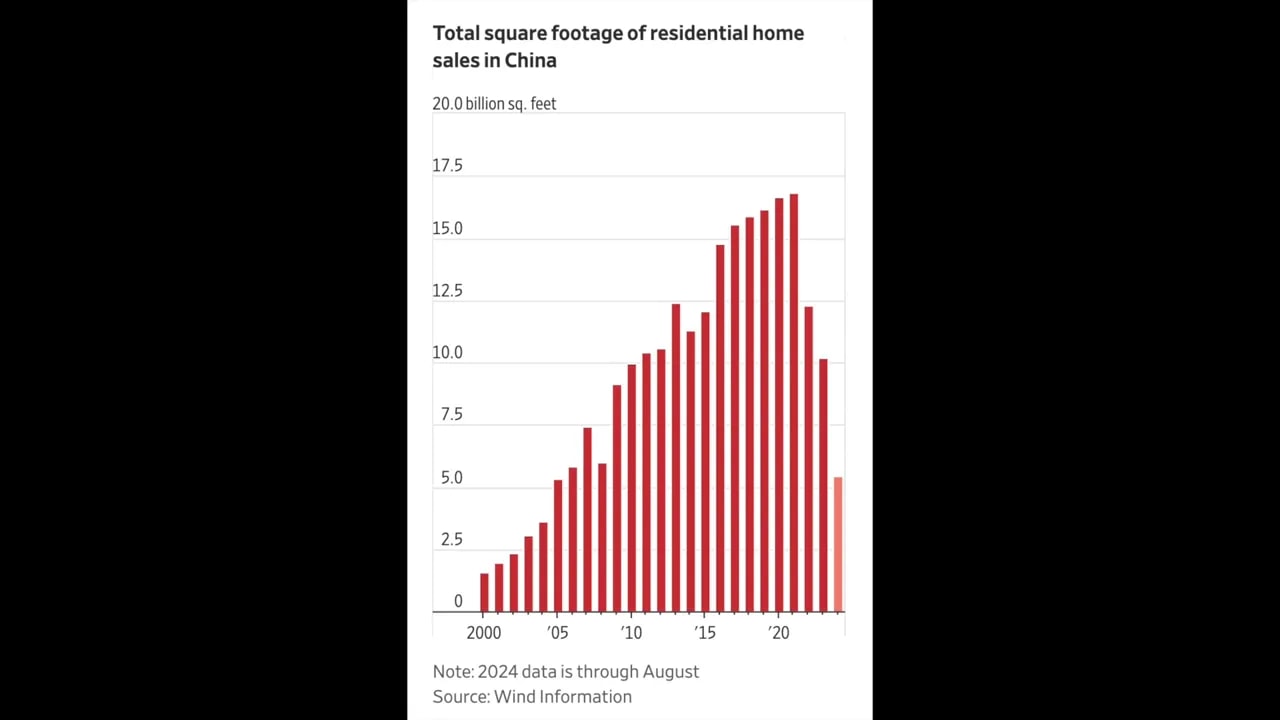
A new analysis cited in the coverage, from Bloomberg Economics, suggests that a sharp decline in construction activity since its 2021 peak is gradually bringing supply back in line with underlying demand.
What “55% collapse” implies: overbuilding was massive
The scale of the prior boom is part of what makes the adjustment so painful. In 2021 alone, new construction reached about 1.56 billion square meters. One way the coverage explains the magnitude is that this is equivalent to building more than eight Manhattans in a single year.
Economists estimated that construction would need to fall by roughly 55% to rebalance the market. Since then, property investment has dropped about 40%. If the original adjustment estimate was accurate, then around 70% of the required market correction may have already been completed.
Stabilization could arrive by 2027 or early 2028, but the critical caveat is that this would not be recovery to the old boom period. It would be a “new normal” at about half the former rate.
In other words, the system may stop bleeding, but it will not go back to growing explosively.
Why the “new normal” is still a problem: housing gluts and demographic decline
Even if construction slows enough to stabilize prices, the underlying balance-sheet and demographic pressures remain. The coverage cites a glut of housing estimated at around 90 million empty units (assuming three people per household), enough for the entire population of Brazil.
On top of that is a structural decline in demand tied to China’s one-child policy. Population trends in urban China are expected to fall by 204 million people over the next 30 years, using a conservative estimate.
This combination changes the long-term math for developers and local governments. The former golden years of explosive housing growth are described as over, not delayed.
What stabilization might look like in the data
Early signals of a new normal include:
- Price declines moderating
- Some cities seeing modest gains
The reason this matters goes beyond real estate. Real estate still makes up an estimated 60 to 90% of household wealth in China (previously closer to 80 to 90%). So even partial stabilization can help restore consumer confidence and reduce the incentive to cut spending.
Transition risk: moving from property-led growth to something else
The longer-term question is whether China can transition to a different growth model. The coverage notes that housing is still expected to be significant, but its share of GDP is declining as high-tech and green industries expand.
Even if the transition succeeds, the new growth rate is likely to be much slower. And if policymakers cannot pull it off, China could face stagnation at best.
4) Singapore’s “tightrope” approach: strategic autonomy in a fragmented world
The final story in the China Update News sweep focuses on strategy and alignment. Singapore is a useful benchmark because it is ethnically Chinese, culturally distinct, heavily westernized in language and institutions, and located at a regional crossroads.
In remarks cited from a Reuters interview, Singapore’s Foreign Minister Vivian Balakrishnan described navigating a world increasingly shaped by great power rivalry rather than cooperation.
The United States as a “revisionist” power and the end of a stable order
Balakrishnan characterized the United States as a “revisionist power of its own system,” emphasizing what he sees as a striking departure from decades when Washington underpinned a rules-based global system built on multilateralism and open trade.
In his assessment, that era has ended and has been replaced by a more fragmented, distrustful environment. Yet Singapore is not “turning to China as an alternative anchor.” Instead, the country is doubling down on strategic autonomy: making decisions based on its long-term interests even if it means saying no to both Washington and Beijing.
Economic constraints: ties with both are not optional
The balancing act is not just political theater. Singapore’s economic structure limits what it can do.
- The United States remains a major source of foreign investment and a key services trading partner.
- China dominates goods trade.
Severing ties with either is not described as economically viable, so Singapore instead seeks to hedge. That includes strengthening relationships with middle powers such as Europe, India, and Japan, while expanding trade agreements and digital economy partnerships.
Global consequence: supply chains now behave like geopolitical leverage
At the macro level, the remarks reflect broader change: trust erodes, and the weaponization of trade, technology, and finance becomes more common. Even supply chains, which used to be stabilizing forces, can turn into tools of leverage.
The risk scenario highlighted is escalation in flashpoints like Taiwan or the South China Sea. In such events, difficult choices can arise, including whether to grant military access to partners.
Singapore’s posture is readiness without provocation, summarized in a tightrope metaphor: constant motion, careful balance, and no room for missteps.
China’s “bigger role” claim meets pushback on trade responsibility
Separately, Singapore’s Prime Minister Lawrence Wong said at a forum that China can play a bigger role in supporting regional prosperity and stability, with its large domestic market serving as an engine of growth for the region.
A response from Michael Pettis, a Peking University professor of finance (as cited in the coverage), argued that this statement contains “quite a bit of hypocrisy.”
Pettis’s core point is that if the United States does not absorb the trade surpluses of countries like Singapore, then adjustment must occur somewhere. He suggests that China would be asked to reverse its trade position and that Singapore would not be willing to reverse its own policies that maintain weaker domestic demand.
In Pettis’s view, a better outcome would be for trade surplus countries to either raise relative domestic demand or direct surpluses into productive investment in capital-constrained developing economies. Both options are costly or risky, but shifting the burden to someone else distorts the global adjustment process.
FAQ
What was the incident at the Chinese embassy in Tokyo?
A person reportedly jumped the wall of the Chinese embassy in Tokyo and threatened diplomatic staff with a knife. No injuries were reported, and Tokyo police took over the case.
Why did the embassy incident become part of a larger Japan-China narrative?
Because Chinese officials and state media portrayed it as evidence of deeper far-right and neo-militarism trends in Japan, rather than treating it strictly as an isolated criminal act.
What does “55% collapse” refer to in China’s property story?
The coverage explains that economists estimated construction needed to fall about 55% from the 2021 peak to rebalance an overbuilt property market. It is used as a shorthand for the magnitude of the adjustment required.
Does stabilization in China’s property market mean recovery?
No. The coverage emphasizes that stabilization would be a new normal at roughly half the former rate, not a return to the boom years.
What is Singapore’s strategy amid US-China rivalry?
Singapore aims for strategic autonomy, refusing full alignment with either side. It hedges by strengthening ties with middle powers and expanding partnerships beyond just the US and China.
Bottom line: three stories, one shared theme
China Update News this week links security narratives, economic adjustment, and alliance strategy into one theme: the environment is becoming less forgiving for “business as usual.” Japan’s response to pressure suggests coercion can accelerate strategic change. China’s property numbers suggest the bleeding may slow, but structural constraints remain. Singapore’s remarks suggest small states are preparing for volatility by tightening autonomy rather than assuming stable great power cooperation.
The big risk is not any single policy move. It is misunderstanding the direction of change, and assuming the other side will act as it did in the past.